


Yuhong Holding Group Co.,LTD

If you have quoted pipe fittings recently, you may have noticed something: the price gap on the same flange or elbow is wider than it was a few years ago. The pipe fitting industry is undergoing a structural split. Standard carbon steel products are locked in a price war, while for high-performance fittings such as duplex steel and nickel-based alloys, buyers care far more about “can it be delivered on time” and “does it carry the right certifications.”
The global pipe fitting market is clearly layering into two tiers. According to industry research, China’s pipe fitting industry revenue is expected to reach RMB 290 billion in 2026, but growth is uneven. Overcapacity pressure on conventional carbon steel commodity fittings continues, while three categories — nickel-based alloy fittings, duplex stainless steel fittings and titanium alloy fittings — are growing significantly faster than the industry average.
| Product Category | Expected 2026 Growth |
|---|---|
| Nickel-based alloy fittings | 9.2% |
| Duplex stainless steel fittings | 8.5% |
| Titanium alloy fittings | 11.3% |
| Industry average | 6.8% |
The same shift is visible on the export side. The export share of stainless and alloy steel reducers has risen from under 20% in 2020 to roughly 30% in 2025. By 2026, high-grade material reducers are expected to account for 34%–37% of exports, with duplex stainless steel reducers seeing especially strong demand in offshore engineering and LNG terminal projects.
The shift comes from an upgrade in downstream application scenarios:
These scenarios have pushed requirements from “meets the standard” to “guarantees safety under extreme conditions.” For a high-pressure thick-wall fitting used at an LNG terminal, buyers will not gamble leakage risk to save 5% on procurement cost. Procurement logic is shifting from price-driven to total-lifecycle-cost-driven, where seal reliability, corrosion resistance and the completeness of compliance documentation become the key considerations.
Take the petrochemical sector. Selection standards for fittings under highly corrosive conditions are already very clear:
The processing requirements for these materials far exceed those of ordinary carbon steel. For Inconel 625, the forging range is 900–1175°C and flow stress is significantly higher than carbon steel, so the same geometry needs roughly twice the forging load. Ultrasonic testing requires dedicated calibration standards rather than steel standards, and probe frequency must be optimized. A supplier’s equipment and process capability is itself a screening threshold.
Tiered competition is now the established pattern: low-end carbon steel commodity products face overcapacity and intense price competition, while high-end alloy steel, duplex steel and nickel-based alloy products carry high technical and qualification barriers — and broad room for import substitution.
For a buyer evaluating suppliers, choosing the right partner matters more than simply bargaining. A supplier with high-end material processing capability, a complete testing system and material traceability can help a project avoid delivery and quality risks that far outweigh a tiny difference in unit price.
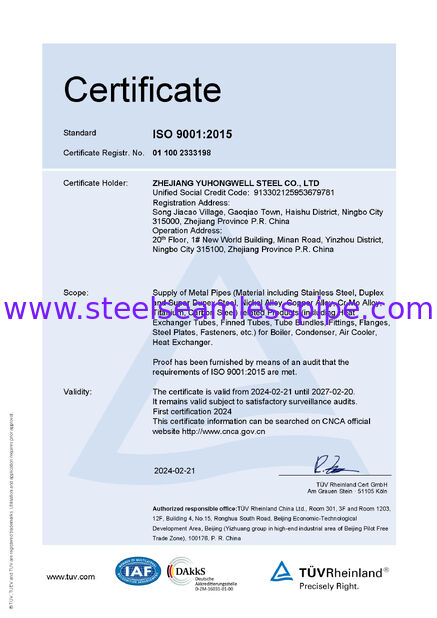
We focus on duplex steel, stainless steel and nickel-based alloy fittings, covering mainstream grades such as UNS S31803 and UNS S32750, and can provide material certificates, third-party inspection reports and complete traceability documentation. If your project is moving from general carbon steel fittings to high-performance materials, contact our technical team for selection advice and a quotation.
Contact Person: Mr. Jikin Cai
Tel: +86-13819835483
Fax: 0086-574-88017980


