
logo

Yuhong Holding Group Co.,LTD
Products
About Us
Factory Tour
Quality Control
Contact Us
Company News
Home News

Helical Baffles (Spiral Baffle System) vs. Traditional Conventional Baffles

Certifications
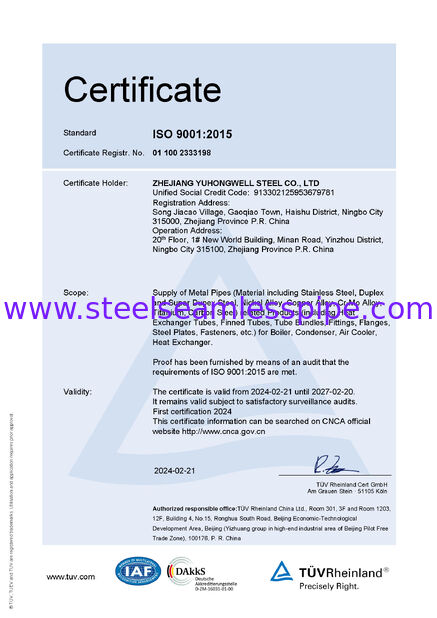
China Yuhong Group Co.,Ltd certification
Customers Reviews
Yuhong Group work as team with us start from 2003, and support excellent service for us last 9 years of steel pipe/tube

—— Singapore---Mr. How

Stable quality , good price, excellent serive, Yuhong Special Steel already become our partner in business team.

—— Colombia ---LEO

Good quality , we like that ! And delivery time in time also , that is why we place repeat order for Yuhong Special Steel .

—— Dubai ---Nazaad

boiler tube / heat exchanger tube expert . We like your quality .

—— USA- JAMES

I'm Online Chat Now
Company News
Helical Baffles (Spiral Baffle System) vs. Traditional Conventional Baffles
Latest company news about Helical Baffles (Spiral Baffle System) vs. Traditional Conventional Baffles

Helical Baffles (Spiral Baffle System) vs. Traditional Conventional Baffles


Helical Baffles (Spiral Baffle System) vs. Traditional Conventional Baffles

Conventional baffles almost always refer to segmental baffles (cut plate baffles)—the most widely used standard design for shell-and-tube heat exchangers. Helical/spiral baffles are an advanced alternative with fundamentally different flow mechanics, performance, pressure drop, and structural traits. Below is a full comparison of core differences:

1. Flow Pattern (Most Fundamental Distinction)

Conventional Segmental Baffles

  • Plates with a vertical horizontal cut (typically 20–25% baffle cut), spaced apart along the shell axis.
  • Fluid flow: zig-zag cross flow + dead recirculation zones
     
    Shell fluid hits the baffle plate, forced to turn 180°, cross perpendicular to tubes, then reverse direction at the next baffle.
  • Large stagnant dead zones behind each baffle plate; fluid recirculates slowly in these areas.
 

Helical/Spiral Baffles

  • Continuous curved spiral plates wrapped around the tube bundle, forming a single helical flow channel.
  • Fluid flow: smooth continuous spiral longitudinal flow
     
    Shell-side fluid moves along a constant helical path, flowing parallel + slightly tangential to tubes with no sharp 180° turns.
  • No large dead zones; flow stays uniform across the entire tube bundle.
 

2. Heat Transfer Performance

Conventional Baffles

 
  • Local high turbulence only at cross-flow sections; dead zones have low heat transfer.
  • Average heat transfer coefficient (h) moderate; significant portion of the shell volume contributes little to heat exchange.
  • Prone to temperature stratification in large exchangers.
 

Helical Spiral Baffles

 
  • Consistent swirling turbulence across all tubes throughout the shell length.
  • Eliminates stagnant regions → 20–40% higher shell-side heat transfer coefficient at the same flow velocity.
  • Uniform fluid temperature distribution; far less thermal stratification.
 

3. Pressure Drop

Conventional Segmental Baffles

 
  • Very high pressure loss: each 180° flow reversal creates massive form drag, flow separation, and vortex losses.
  • Pressure drop rises steeply with flow rate; often requires larger pumps/blowers and higher operating energy costs.
 

Helical Spiral Baffles

 
  • Minimal flow turning losses—no abrupt directional reversals.
  • For equal heat transfer duty: 50–70% lower shell-side pressure drop.
  • If operating at the same pressure drop as conventional baffles, helical designs deliver far higher heat transfer efficiency.
 

4. Fouling & Cleaning Behavior

Conventional Baffles

 
  • Dead zones trap sediment, sludge, scale, and particulates.
  • Low velocity recirculation zones accelerate fouling buildup; frequent cleaning required.
  • Hard to flush trapped deposits between baffle plates.
 

Helical Spiral Baffles

 
  • Continuous swirling flow scours tube surfaces uniformly; no low-speed stagnant pockets.
  • Much slower fouling rate; extended service intervals between cleaning.
  • Straight-through spiral channel enables easier chemical flushing or mechanical cleaning.
 

5. Flow-Induced Tube Vibration (Critical Reliability Difference)

Conventional Baffles

 
  • Severe cross-flow perpendicular to tubes + rapid flow reversal creates strong vortex shedding.
  • High risk of tube vibration, tube collision, tube wear at baffle cut edges, and tube rupture over time—major failure risk in high-flow exchangers.
 

Helical Spiral Baffles

 
  • Flow runs mostly parallel to tubes with gentle swirling, minimal transverse cross-flow excitation.
  • Vortex shedding is suppressed; tube vibration risk is drastically reduced.
  • Longer tube service life, fewer maintenance repairs for tube damage.
 

6. Structural & Mechanical Features

Conventional Segmental Baffles

Pub Time : 2026-06-20 10:38:14 >> News list
Contact Details
Yuhong Group Co.,Ltd

Contact Person: Mr. Jikin Cai

Tel: +86-13819835483

Fax: 0086-574-88017980

Send your inquiry directly to us (0 / 3000)