


Yuhong Holding Group Co.,LTD
 |
| Place of Origin: | CHINA |
| Brand Name: | YUHONG |
| Certification: | ABS, GL, DNV, NK, PED, AD2000, GOST9941-81, CCS, ISO 9001-2008 |
| Model Number: | ASME SA268 TP410 |
| Minimum Order Quantity: | 500kgs |
|---|---|
| Price: | Negotiable |
| Packaging Details: | Ply-wooden Case /Iron Case/ Bundle with plastic Cap |
| Delivery Time: | 15-30days |
| Payment Terms: | L/C,T/T |
| Supply Ability: | According to Clients' requirements |
| Highlight: | Heat Exchanger Stainless Steel Seamless Tube,ASME SA268 TP410 Seamless Tube,Martensitic Stainless Steel Seamless Tube |
||
|---|---|---|---|
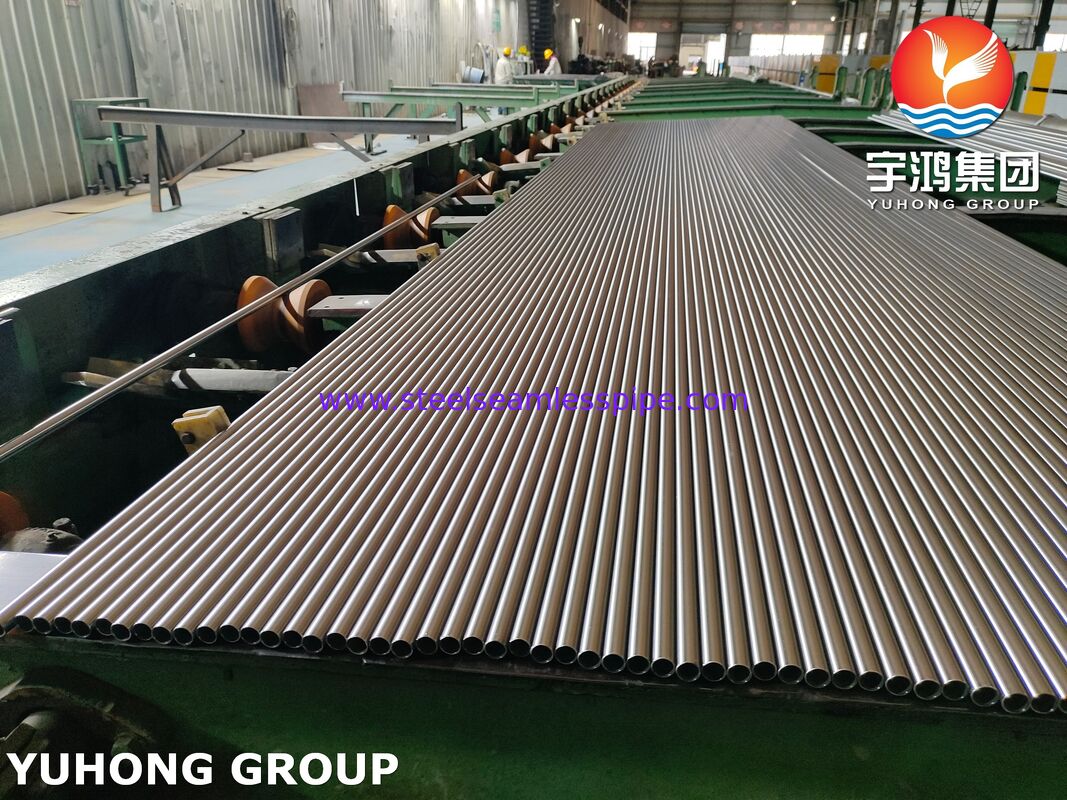
ASME SA268 TP410 Stainless Steel Seamless Tubes are manufactured for heat exchanger systems where mechanical strength, hardness, wear resistance, and moderate corrosion resistance are important operating requirements. Produced in accordance with ASME SA268/SA268M, these tubes belong to the martensitic stainless steel family and are identified by UNS S41000. The material contains approximately 11.5–13.5% chromium and a controlled carbon content of up to 0.15%, providing a combination of strength, hardenability, and resistance to oxidation in suitable service environments.

For industrial heat exchangers, TP410 seamless tubes can be considered for tube bundles, tubular heat transfer assemblies, and equipment handling mildly corrosive fluids, provided that the operating temperature, pressure, fluid chemistry, and corrosion allowance are compatible with the material. Typical evaluation scenarios include non-chloride process water, selected industrial oil circuits, and other process streams where moderate corrosion resistance and mechanical durability are required. The seamless manufacturing route eliminates the longitudinal weld seam, making the tubes suitable for applications where uniform tube-wall integrity and consistent dimensional quality are required.
Compared with conventional austenitic stainless steel grades such as TP304 and TP316L, TP410 offers a different performance balance. Its martensitic structure allows heat-treatment-based hardening and provides higher hardness potential, while its corrosion resistance and weldability are more limited. It should therefore not be automatically selected for seawater, high-chloride cooling water, strongly acidic media, or highly aggressive chemical environments. For such applications, TP316L, duplex stainless steel, or other corrosion-resistant alloys may provide a more appropriate solution.
Our ASME SA268 TP410 stainless steel seamless tubes can be supplied in project-specific outside diameters, wall thicknesses, and lengths, with material traceability and inspection documentation available according to purchase-order requirements. Chemical composition, tensile properties, hardness, dimensional tolerances, surface condition, and applicable nondestructive examination can be verified before delivery. The final supply specification can be coordinated with the heat exchanger design requirements, applicable ASME construction code, and purchaser's inspection plan.
TP410 seamless tubes are intended for heat exchanger applications where the operating environment does not require the high corrosion resistance of austenitic or duplex stainless steels, but where strength, hardness, and material durability remain important.
|
Application scenario |
Operating conditions |
TP410 tube function |
Engineering consideration |
|---|---|---|---|
|
Industrial oil coolers |
Oil-to-water or oil-to-air heat transfer |
Provides a pressure-containing heat transfer passage |
Verify oil chemistry and water-side corrosion conditions |
|
Industrial process water heat exchangers |
Low-chloride process water |
Transfers heat between process water circuits |
Evaluate dissolved oxygen, pH and chloride concentration |
|
Machinery cooling systems |
Circulating cooling fluids |
Provides mechanically durable heat transfer tubing |
Assess erosion, vibration and flow velocity |
|
Selected refinery auxiliary heat exchangers |
Compatible hydrocarbon and utility streams |
Provides a tube-wall barrier between process and utility fluids |
Confirm fluid composition and design-code requirements |
|
Industrial heat recovery equipment |
Compatible non-aggressive process streams |
Supports heat transfer under specified pressure and temperature conditions |
Check oxidation, thermal cycling and material compatibility |
Important application qualification: TP410 is not a universal replacement for TP304, TP316L or duplex stainless steel in heat exchanger construction. The suitability of the material must be established through process-fluid analysis, corrosion evaluation, mechanical design and operating-temperature assessment.
|
Engineering challenge |
TP410 material characteristic |
Practical benefit |
|---|---|---|
|
Insufficient surface hardness in service |
Martensitic microstructure can be hardened through suitable heat treatment |
Improved resistance to mechanical wear |
|
Mechanical strength requirements |
Minimum tensile strength of 415 MPa under the specified annealed condition |
Supports the required tube-wall mechanical performance |
|
Moderate oxidation exposure |
Chromium content of 11.5–13.5% |
Provides oxidation resistance in suitable environments |
|
Tube-wall integrity requirements |
Seamless manufacturing process |
Avoids a longitudinal weld seam |
|
Dimensional consistency |
Controlled OD, wall thickness and straightness |
Supports tube-sheet fitting and bundle assembly |
|
Material traceability |
Heat-number identification and material test documentation |
Supports incoming inspection and project quality control |
|
Standard |
Description |
Application |
|---|---|---|
|
ASME SA268/SA268M |
Seamless and Welded Ferritic and Martensitic Stainless Steel Tubing for General Service |
Main material and manufacturing specification |
|
ASTM A268/A268M |
Equivalent ASTM specification for ferritic and martensitic stainless steel tubing |
Material procurement and inspection |
|
ASME BPVC Section II, Part A |
Ferrous Material Specifications |
Material specification reference for ASME construction |
|
ASME BPVC Section VIII |
Rules for Construction of Pressure Vessels |
Applicable when the heat exchanger falls within its scope |
|
ASME BPVC Section IX |
Welding, Brazing, and Fusing Qualifications |
Applicable welding qualification requirements when relevant |
|
ASME SA1016/SA1016M |
General Requirements for Ferritic Alloy Steel, Austenitic Alloy Steel, and Stainless Steel Tubes |
General supplementary tube requirements, where invoked |
Compliance documentation available according to order requirements:
EN 10204 3.1 Material Inspection Certificate.
Heat number and material traceability records.
Chemical composition test report.
Mechanical property test report.
Hardness test report.
Dimensional inspection report.
Hydrostatic or nondestructive electric test records, as applicable.
Nondestructive examination records, where specified.
Heat treatment records, where required.
Packing list and product identification records.
Documentation preview note: The above images are illustrative references, not actual certificates for the supplied material. Actual MTCs and inspection reports must correspond to the delivered heat numbers and purchase order.
|
Item |
Description |
|---|---|
|
Product name |
TP410 Stainless Steel Seamless Tube |
|
Material grade |
TP410 |
|
UNS designation |
S41000 |
|
Material category |
Martensitic Stainless Steel |
|
Product standard |
ASME SA268/SA268M |
|
Equivalent ASTM standard |
ASTM A268/A268M |
|
Manufacturing process |
Seamless |
|
Manufacturing method |
Hot finished / Cold finished |
|
Heat treatment |
As required by SA268 and the ordered product condition |
|
Surface finish |
Pickled / Annealed / Polished, as agreed |
|
Outside diameter |
Project-specific |
|
Wall thickness |
Project-specific |
|
Length |
Random / Fixed / Cut-to-length |
|
Inspection |
Chemical, mechanical, dimensional and applicable NDT |
|
Application |
Industrial Heat Exchangers |
The following is a suggested commercial supply range for heat exchanger projects. These are indicative product options, not a claim that every size is explicitly prescribed by SA268.
|
Parameter |
Common supply range |
|---|---|
|
Outside diameter (OD) |
6 mm – 114.3 mm |
|
Wall thickness (WT) |
0.8 mm – 12.7 mm |
|
Length |
3 m – 12 m |
|
Standard length options |
5.8 m / 6 m / 9 m / 12 m |
|
Manufacturing condition |
Annealed, as specified |
|
Delivery form |
Straight tubes |
|
End preparation |
Plain ends / Beveled ends, as agreed |
For heat exchanger tube bundles, smaller outside diameters and controlled wall thicknesses are commonly specified to meet heat transfer and tube-sheet design requirements. Larger diameters may be selected for particular tubular heat transfer assemblies.
Actual availability depends on manufacturing capability, production route, material condition and dimensional tolerances. Special dimensions can be evaluated against the purchaser's drawings and technical specifications.
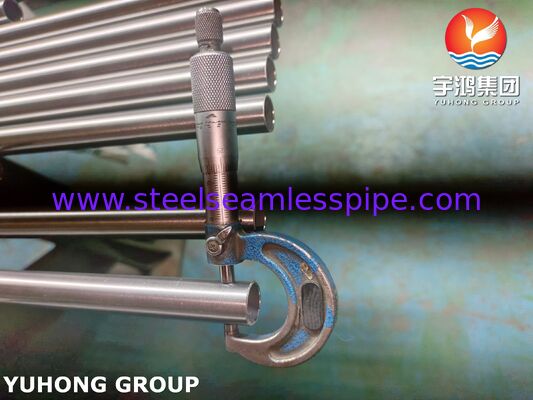
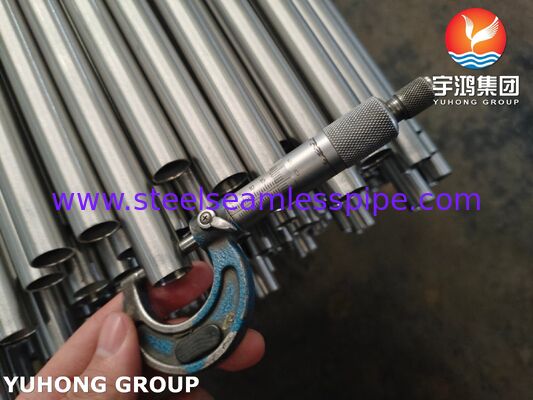
Dimensional inspection is particularly important for heat exchanger tubes because outside diameter and wall thickness affect tube-sheet installation, pressure resistance and heat transfer performance.
|
Inspection item |
Control requirement |
|---|---|
|
Outside diameter |
According to ordered dimensions and applicable standard tolerances |
|
Wall thickness |
According to ordered nominal thickness and specified tolerance |
|
Length |
According to purchase order |
|
Ovality |
Controlled according to applicable dimensional requirements |
|
Straightness |
Checked against agreed acceptance criteria |
|
Surface condition |
Free from unacceptable cracks, laps and other detrimental defects |
|
End condition |
Plain or prepared according to customer requirements |
Final dimensional tolerances must be confirmed against the applicable edition of SA268/SA268M, its referenced general requirements and the purchase order. Do not apply generic tolerances without checking the specified size and manufacturing condition.
ASME SA268 TP410 is a chromium-containing martensitic stainless steel. Its chemical composition is designed to provide hardenability and mechanical strength while maintaining moderate corrosion resistance.
Typical specification limits, mass percentage (%), based on ASTM A268/A268M-24 TP410 requirements.
|
Element |
Symbol |
Composition (%) |
|---|---|---|
|
Carbon |
C |
≤ 0.15 |
|
Chromium |
Cr |
11.5 – 13.5 |
|
Manganese |
Mn |
≤ 1.00 |
|
Silicon |
Si |
≤ 1.00 |
|
Phosphorus |
P |
≤ 0.040 |
|
Sulfur |
S |
≤ 0.030 |
|
Nickel |
Ni |
No specific limit listed for TP410 in the cited table |
|
Molybdenum |
Mo |
No specific limit listed for TP410 in the cited table |
Chemical composition considerations
Chromium provides the passive oxide film responsible for the material's basic corrosion and oxidation resistance.
Carbon contributes to hardenability and strength after appropriate heat treatment.
Manganese and silicon support steelmaking and deoxidation.
Phosphorus and sulfur are controlled to limit undesirable effects on material quality.
The final chemical composition must be confirmed through heat analysis and the actual mill test certificate. A purchaser may specify additional chemical restrictions if required by the project.
For TP410 tubing in the specified annealed condition, the following values are the standard minimum or maximum requirements commonly referenced for ASTM A268/ASME SA268.
|
Mechanical property |
Requirement |
Unit |
|---|---|---|
|
Tensile strength |
≥ 415 |
MPa |
|
Yield strength (0.2% offset) |
≥ 205 |
MPa |
|
Elongation |
≥ 20 |
% |
|
Brinell hardness |
≤ 207 |
HBW |
|
Rockwell B hardness |
≤ 95 |
HRB |
Hardness values are presented as corresponding reference limits; the applicable test method and acceptance requirements should be confirmed against the governing edition of the standard.
|
Property |
Engineering significance |
Benefit in application |
|---|---|---|
|
Tensile strength |
Resistance to tensile loading |
Supports tube-wall structural requirements |
|
Yield strength |
Resistance to permanent deformation |
Helps maintain tube geometry under design loading |
|
Hardness |
Resistance to indentation and surface damage |
Useful where moderate mechanical wear is a concern |
|
Elongation |
Plastic deformation capability before fracture |
Provides a measure of material ductility |
|
Heat-treatment response |
Ability to develop higher hardness through heat treatment |
Allows mechanical properties to be adjusted for suitable applications |
Important: The minimum mechanical properties above apply to the specified standard condition. Do not advertise these values as guaranteed properties of a hardened or otherwise specially heat-treated product without supporting test results.
The production of ASME SA268 TP410 seamless tubes requires control of the steelmaking process, tube forming, heat treatment, finishing and final inspection.
|
Manufacturing stage |
Production procedure |
Quality control objective |
|---|---|---|
|
Raw material selection |
Select qualified TP410 steel billets |
Ensure chemical compliance |
|
Steel heating |
Heat billets to suitable forming temperatures |
Maintain stable forming conditions |
|
Hot piercing |
Produce hollow tube shells |
Establish initial tube geometry |
|
Hot rolling |
Reduce OD and wall thickness |
Achieve preliminary dimensions |
|
Cold drawing / Cold finishing |
Refine dimensions and surface quality |
Improve dimensional consistency |
|
Heat treatment |
Apply the specified final heat treatment |
Meet mechanical and metallurgical requirements |
|
Pickling and finishing |
Remove surface scale and processing residues |
Improve surface cleanliness |
|
Straightening |
Correct tube deformation |
Maintain straightness |
|
Cutting |
Cut tubes to specified lengths |
Meet dimensional requirements |
|
Final inspection |
Conduct mechanical, dimensional and applicable NDT checks |
Verify product acceptance |
TP410 is a hardenable martensitic stainless steel. Heat treatment is an important part of its manufacturing process because it influences hardness, strength, ductility and metallurgical condition.
For standard SA268 supply, the final heat treatment must comply with the requirements of the applicable edition of the specification. The required treatment is not interchangeable with an arbitrary hardening and tempering cycle.
Where a purchaser requires a special hardness condition or modified mechanical properties, the manufacturer must review the technical requirements and confirm that the proposed treatment is compatible with the product specification.
Quality inspection is essential for TP410 heat exchanger tubes because material composition, mechanical properties, wall thickness and surface integrity directly affect equipment reliability.
Chemical analysis is performed to verify that the TP410 material complies with the specified chemical composition.
Common inspection methods:
Optical Emission Spectrometry (OES).
Laboratory chemical analysis.
Positive Material Identification (PMI), when specified.
The inspection verifies chromium, carbon, manganese, silicon, phosphorus and sulfur contents, together with any additional elements required by the purchase specification.
|
Test |
Purpose |
Applicable requirement |
|---|---|---|
|
Tensile test |
Measures tensile strength, yield strength and elongation |
SA268 requirements |
|
Hardness test |
Verifies material hardness |
Brinell or Rockwell method |
|
Flaring test |
Evaluates tube-end expansion resistance |
Applicable to seamless tubing |
|
Flattening test |
Evaluates deformation resistance |
When required by the specification |
|
Reverse flattening test |
Checks tube material integrity |
Applicable where specified |
|
Flange test |
Evaluates tube-end flanging |
Primarily for welded tubing, not a routine seamless-tube test |
|
Inspection method |
Inspection purpose |
Application |
|---|---|---|
|
Eddy Current Testing (ET) |
Detects surface and near-surface discontinuities |
Tube integrity examination |
|
Ultrasonic Testing (UT) |
Detects internal discontinuities and evaluates wall thickness |
Additional examination when specified |
|
Hydrostatic Testing |
Checks pressure-containing integrity and leakage |
When required by the specification |
|
Visual Testing (VT) |
Checks surface defects and workmanship |
Final product inspection |
|
Dimensional Inspection |
Measures OD, WT, length and straightness |
Every production lot according to inspection plan |
|
PMI |
Confirms material grade identity |
Project-specific material verification |
Testing compliance: SA268 provides requirements for tension, flaring, flange, hardness, reverse flattening, intergranular corrosion and hydrostatic or nondestructive electric testing, as applicable to the product type and ordered requirements. Additional UT, PMI or other examinations should be specified in the purchase order or Inspection and Test Plan (ITP).
|
Document |
Information provided |
|---|---|
|
MTC EN 10204 3.1 |
Material grade, heat number, chemical and mechanical results |
|
Chemical Analysis Report |
Actual chemical composition |
|
Mechanical Test Report |
Tensile and hardness test results |
|
Heat Treatment Record |
Heat treatment process and production records |
|
NDT Report |
Examination method and inspection results |
|
Dimensional Inspection Report |
OD, WT, length and dimensional measurements |
|
Packing List |
Quantity, dimensions and package identification |
|
ITP |
Inspection stages, methods and acceptance requirements |
Material selection is an important consideration in heat exchanger engineering. Different stainless steel grades provide different combinations of corrosion resistance, strength, hardness and fabrication characteristics.
|
Property |
TP410 |
TP304 |
TP316L |
TP409 |
|---|---|---|---|---|
|
Material family |
Martensitic |
Austenitic |
Austenitic |
Ferritic |
|
UNS |
S41000 |
S30400 |
S31603 |
S40900 |
|
Chromium |
11.5–13.5% |
18–20% |
16–18% |
10.5–11.7% |
|
Nickel |
No specific limit in TP410 table |
8–10.5% |
10–14% |
≤ 0.50% |
|
Molybdenum |
No specific limit in TP410 table |
No intentional addition |
2–3% |
No intentional addition |
|
Hardening by heat treatment |
Yes |
No |
No |
No |
|
Strength and hardness potential |
Higher after suitable hardening |
Moderate |
Moderate |
Relatively low |
|
General corrosion resistance |
Moderate |
Good |
Better in many chloride-containing environments |
Limited to moderate |
|
Welding characteristics |
Requires more care |
Good |
Good |
Requires appropriate procedures |
Composition ranges are representative standard-grade limits and should be checked against the relevant material specifications.
|
Application requirement |
Material to evaluate |
Reason |
|---|---|---|
|
Mechanical strength and hardening potential |
TP410 |
Martensitic heat-treatment response |
|
General-purpose industrial heat transfer |
TP304 |
Balanced corrosion resistance and fabrication |
|
Chloride-containing process environments |
TP316L or duplex grades |
Improved resistance in suitable chloride environments |
|
Mildly corrosive exhaust or utility applications |
TP409 or TP410, subject to temperature and corrosion evaluation |
Application-dependent ferritic/martensitic material selection |
|
Strongly corrosive chemical media |
Higher-alloy stainless steel or nickel alloy |
Greater corrosion resistance may be necessary |
TP410 should be selected based on actual operating conditions rather than price or strength alone. For heat exchangers exposed to seawater, concentrated chlorides or aggressive chemical fluids, a corrosion-resistant alternative should be evaluated.
The following parameters should be reviewed when selecting TP410 seamless tubes for heat exchanger equipment.
|
Parameter |
Engineering consideration |
|---|---|
|
Operating temperature |
Verify material strength, oxidation resistance and metallurgical stability at the actual temperature |
|
Design pressure |
Calculate required tube-wall thickness using the applicable design code |
|
Working medium |
Evaluate chemical composition, pH, chloride concentration and corrosive components |
|
Flow velocity |
Assess erosion, turbulence and possible vibration |
|
Thermal cycling |
Consider thermal expansion and fatigue loading |
|
Tube-side pressure |
Check internal pressure and external pressure conditions |
|
Shell-side pressure |
Evaluate external pressure and differential pressure |
|
Corrosion allowance |
Establish according to process-fluid corrosion assessment |
|
Tube-to-tubesheet connection |
Confirm compatibility with the specified expansion or welding procedure |
For TP410 heat exchanger tubes, the following issues deserve particular attention:
Corrosion resistance
TP410 has less corrosion resistance than TP304 and TP316L in many aqueous environments. The actual corrosion rate depends on chloride concentration, pH, temperature, dissolved oxygen and other process-fluid components.
Weldability
Because TP410 is a hardenable martensitic stainless steel, welding requires suitable procedures. Preheating, controlled interpass temperatures and post-weld heat treatment may be necessary depending on thickness, restraint, welding procedure and service requirements.
Thermal performance
TP410's thermal conductivity differs from that of austenitic stainless steel. However, the actual heat exchanger performance depends on the complete heat-transfer system, including tube dimensions, flow characteristics, fouling resistance and temperature difference.
Mechanical durability
TP410's ability to develop higher hardness through heat treatment can be beneficial in applications where mechanical wear is a concern. However, higher hardness should not be confused with improved resistance to every form of erosion or corrosion.
ASME SA268 TP410 seamless tubes are packaged to prevent surface damage, contamination and deformation during storage and transportation.
|
Packaging item |
Description |
|---|---|
|
Tube protection |
Plastic end caps when required |
|
Surface protection |
Protective wrapping or suitable packaging |
|
Bundling |
Steel straps with protective separators |
|
Wooden packaging |
Wooden boxes or crates for export orders |
|
Identification |
Grade, size, heat number and quantity |
|
Shipping documents |
Commercial invoice, packing list and MTC |
Custom packaging, marking and shipping arrangements can be provided according to project requirements.
Q1: Is ASME SA268 TP410 suitable for heat exchanger applications?
Yes. TP410 can be considered for heat exchanger tubes operating in compatible process environments where mechanical strength, hardness and moderate corrosion resistance are required. The final selection must be based on fluid chemistry, temperature, pressure and corrosion evaluation.
Q2: What is the difference between TP410 and TP304?
TP410 is a martensitic stainless steel that can be hardened through suitable heat treatment. TP304 is an austenitic stainless steel with generally better corrosion resistance and weldability. The appropriate grade depends on the operating environment and mechanical requirements.
Q3: Can TP410 seamless tubes be used in cooling water systems?
They may be used in selected cooling water systems, provided chloride concentration, water chemistry, temperature and corrosion conditions are suitable. TP410 should not be assumed suitable for seawater or high-chloride cooling water.
Q4: What is the maximum hardness of ASME SA268 TP410?
The commonly specified maximum hardness for TP410 in the standard condition is 207 HBW or approximately 95 HRB. The applicable test method and acceptance requirements should be confirmed against the ordered standard edition.
Q5: What sizes are available for TP410 seamless tubes?
Common commercial supply dimensions include outside diameters from 6 mm to 114.3 mm, with wall thicknesses from 0.8 mm to 12.7 mm. Actual production availability depends on manufacturing capability and order requirements.
Q6: What inspection documents can be provided?
Depending on the purchase order, documents can include EN 10204 3.1 MTC, chemical analysis, tensile test, hardness test, dimensional inspection, heat treatment records and applicable NDT reports.
Q7: Can TP410 tubes be customized for heat exchanger projects?
Yes. Outside diameter, wall thickness, length, surface finish and inspection requirements can be discussed according to the customer's drawings and technical specifications.
We supply stainless steel seamless tubes for industrial heat exchangers and other demanding industrial applications.
Our TP410 tube supply can be coordinated according to project specifications, including:
ASME SA268 TP410 material requirements.
Customized outside diameter and wall thickness.
Project-specific tube lengths.
Chemical and mechanical testing.
Dimensional and nondestructive inspection.
EN 10204 3.1 material certification.
Export packaging and international delivery.
Contact our sales team with your required material grade, tube dimensions, quantity, operating conditions and applicable technical specifications. We will review your requirements and provide a suitable quotation.
Contact Person: Thomas
Tel: +8618858068748
Fax: 0086-574-88017980


Overall Rating
Rating Snapshot
The following is the distribution of all ratingsAll Reviews