Yuhong Holding Group Co.,LTD
 |
| Place of Origin: | CHINA |
| Brand Name: | YUHONG |
| Certification: | ISO, API, ABS, BV, etc |
| Model Number: | ASME SA350 LF2 CL1 Carbon Steel Forged Nozzle |
| Minimum Order Quantity: | 1PC |
|---|---|
| Packaging Details: | Plywood Case or Plywood Pallet |
| Delivery Time: | 7 DAYS |
| Payment Terms: | L/C,T/T |
| Product Name: | Forged Nozzles | Standard: | ASTM A350, ASME SA350 |
|---|---|---|---|
| Material: | LF2, LF3, LF6 | Size: | Can Custom As Per Drawing |
| Coating: | Oil, Black Paint, Yellow Paint, Hot Dip Galvanized, Electrolytic Zinc And Epoxy Resin Coatings | Packing: | Plywood Case, Plywood Pallet |
| Application: | Oil & Gas And Petrochemical Sector, Heat Exchanger, Etc. | ||
| Highlight: | ASME SA350 LF2 carbon steel nozzle,self-reinforced forged steel fitting,integral reinforcement steel nozzle |
||
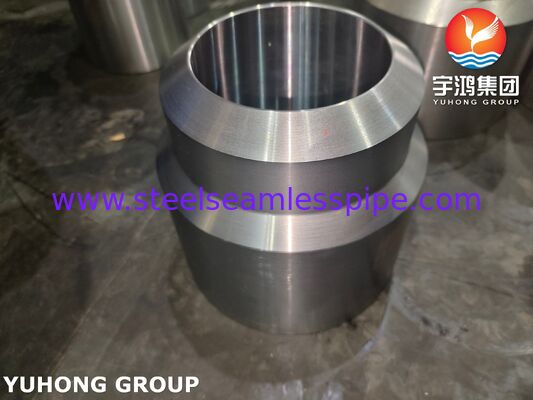
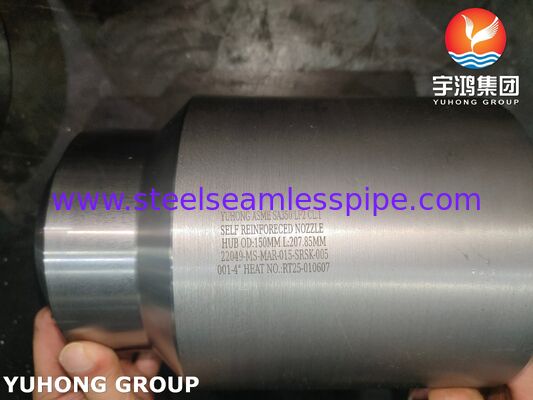
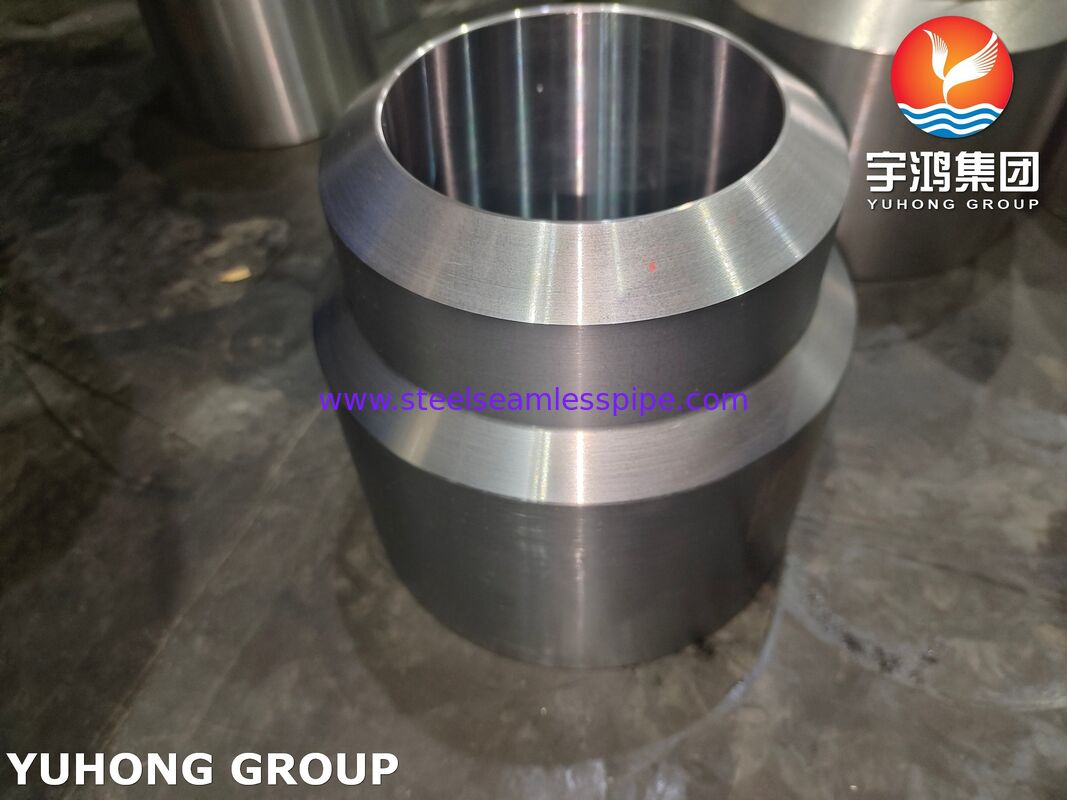
ASME SA350 LF2 CL1 Low-Temperature Carbon Steel Forged Self Reinforced Nozzles
The ASME SA350 LF2 CL1 Low-Temperature Carbon Steel Self-Reinforced Nozzle is a single-piece, hot-forged nozzle manufactured from low-temperature carbon steel conforming to ASME SA350 Grade LF2 Class 1, in which the reinforcement area required around the opening (normally provided by a separate welded reinforcing pad) is integrally forged as part of the nozzle body, thereby eliminating a separate pad-to-shell weld and providing continuous grain flow for enhanced strength and low-temperature toughness down to -46°C (-50°F).
Self-Reinforced Nozzle Design
A self-reinforced nozzle (also called integral reinforcement or forged reinforcement) is a nozzle where the reinforcing pad or extra metal is forged as one piece with the neck, rather than welded on as a separate reinforcing pad.
Key Features:
No separate reinforcement pad – the thickened region is integral to the forging.
Smooth transition between nozzle neck and shell/head attachment.
Reduced stress concentration compared to pad-reinforced nozzles.
Lower risk of weld defects – fewer welds (only the attachment weld to the shell remains).
Improved fatigue and fracture resistance due to continuous grain flow.
Available Standards and Materials
|
F1,F2,F5,F21,F22 Cl.1,F22 Cl.2,F22V,F51,F53,F55,F92, F304,F404L,F304H,F310,F316L, F316Ti, F317,F321,F321H,F347,F347H |
ASTM A182/A182M |
Forged or rolled alloy and stainless steel pipe flanges |
|
UNS N04400/N08811 |
ASTM B564/B564M |
Hot rolled & cold finished steel age hardening stainless bars and shaping |
|
UNS N08800/N08810 |
||
|
UNS N08825/N010276 |
||
|
UNS N06625 |
| A105/A105M | ASTM A105 | Carbon steel for piping components | |
| A350 LF2, A350 LF3, A350 LF6 | ASTM A350/A350M | Carbon and low alloy steel forgings | |
| A266 Gr. 2, A266 Gr. 4 | ASTM A266/A266M | Carbon steel forgings for pressure vessel components | |
| A694 F52, A694 F60, A694 F65,A694 F70 | ASTM A694/A694M | Carbon and alloy steel forgings for pipe, flanges, fittings valves and parts | |
| A765 Gr. I,A765 Gr. II,A765 Gr. III,A765 Gr. IV | ASTM A765/A765M | Carbon and low-alloy steel forgings with mandatory toughness requirements | |
| A508 Gr. 1, A508 Gr. 2,A508 Gr. 3,A508 Gr. 4N | ASTM A508/A508M | Quenched and tempered vacuum-treated carbon and alloy steels | |
| A336 F1,F5,F5A,F11,F22,F22V, F9,F91,F92 | ASTM A336/A336M | Alloy steel forgings for pressure and high temperature parts |
| UNS N08904 | ASTM B625/B625M | Alloy steel forgings |
| UNS N04400 | ASTM B564/B564M | Nikel-copper alloy |
Advantages of Self-Reinforced Design:
Eliminates a Potential Leak Path: The standard "repad" design creates two weld seams that are potential sites for corrosion and leaks. A self-reinforced nozzle has a single, better-designed weld.
Reduces Stress Concentrations: The gradual, contoured shape minimizes stress concentrations at the junction, leading to a longer fatigue life, especially under cyclic loading.
Simplifies Inspection: With fewer welds, non-destructive examination (NDE) like radiography or ultrasonic testing is simpler and more effective.
Better for High-Pressure or Cyclic Service: It is the preferred design for severe service conditions.
Applications
Pressure vessels for low-temperature hydrocarbon service (e.g., propane, butane, LNG storage)
Ammonia and ethylene plants
Offshore platforms (North Sea, Arctic regions)
Cryogenic tanks (liquid nitrogen, oxygen, argon – down to -46°C)
Heat exchangers and reactors subject to thermal cycling
Pulp & paper digesters
Nuclear auxiliary systems (low-impact requirements)

Contact Person: Vivi
Tel: 0086-13023766106
Fax: 0086-574-88017980