Yuhong Holding Group Co.,LTD
 |
| Place of Origin: | China |
| Brand Name: | YUHONG |
| Certification: | ISO9001:2015; ISO14001:2015; ISO45001:2018; PED 2014/68/EU; WPS/PQR/WPQ; ISO 3834 |
| Model Number: | N/A |
| Minimum Order Quantity: | 500kgs |
|---|---|
| Price: | To be discussed |
| Packaging Details: | Plywood case or Iron frame wooden case |
| Delivery Time: | 50-120 days |
| Payment Terms: | L/C,T/T |
| Supply Ability: | 5000 meters/day |
| Material: | ASME SA335 P9 | Application: | Fired Heater |
|---|---|---|---|
| Package: | Plywood Case Or Iron Frame Wooden Case | ||
| Highlight: | ASME SA335 P9 serrated fin tubes,serrated fin tubes for fired heater,alloy steel serrated fin tubes |
||
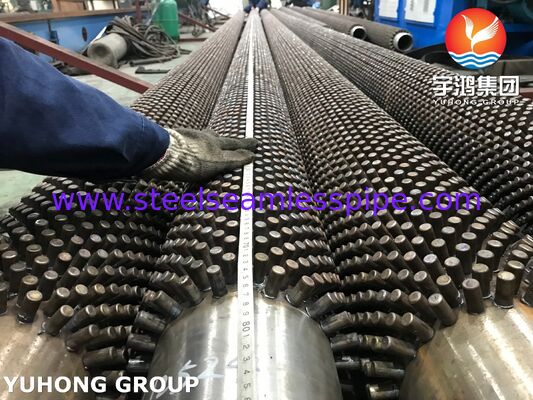
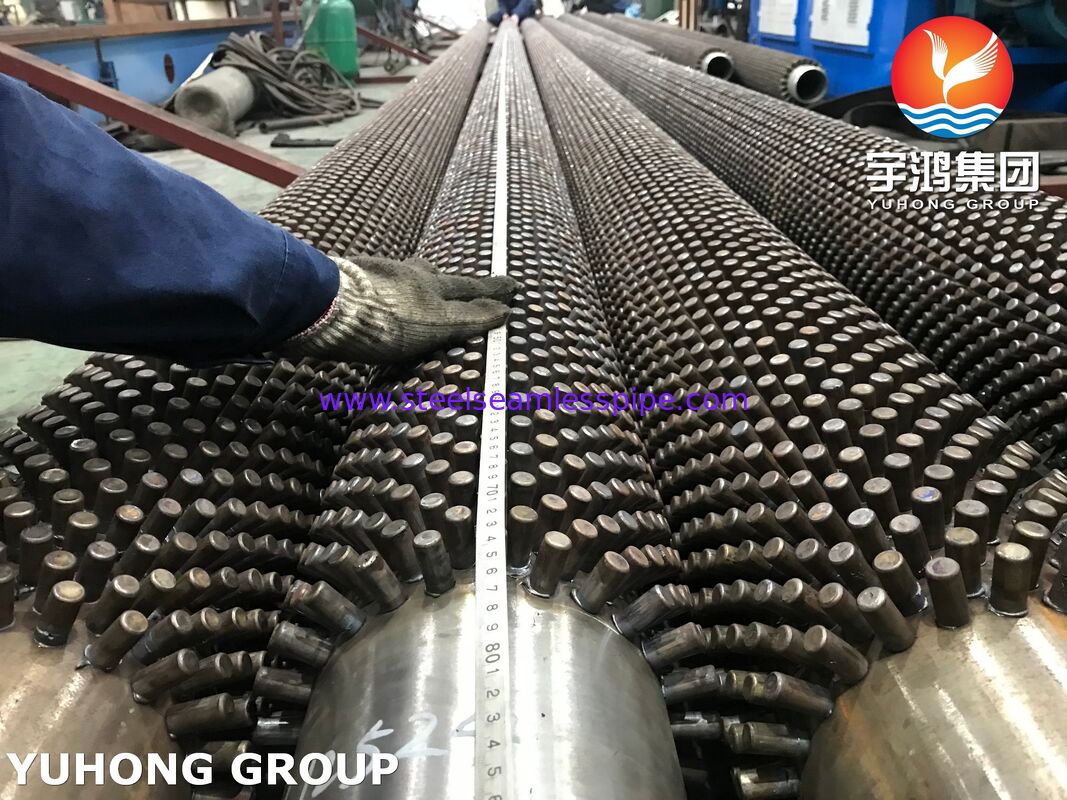
Serrated fin tubes for fired heaters are specially engineered heat-transfer components designed to improve thermal efficiency in high-temperature industrial heating systems. Manufactured using ASME SA335 P9 chromium-molybdenum alloy steel, these tubes offer excellent high-temperature strength, oxidation resistance, and reliable performance under demanding operating conditions.
ASME SA335 P9 is a 9Cr-1Mo alloy steel grade containing approximately 8–10% chromium and 0.90–1.10% molybdenum. Its alloy composition makes it suitable for elevated-temperature pressure-containing applications where conventional carbon steel may not provide sufficient thermal performance or service life.
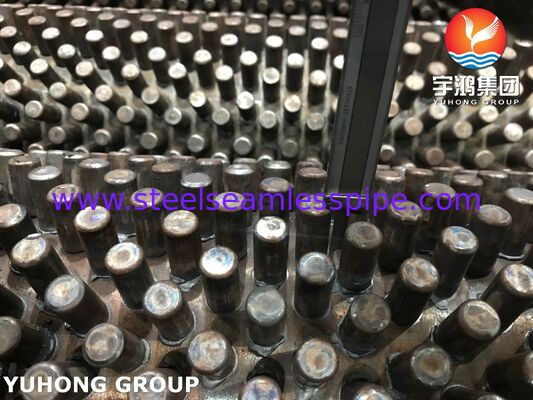
The serrated fin design increases the external heat-transfer surface area while allowing combustion gases to pass through the fin gaps. Compared with solid-fin configurations, serrated fins can improve gas-side turbulence and heat-transfer efficiency while helping control fouling in appropriate operating conditions.
Our serrated fin tubes are manufactured to meet project-specific requirements for fired heaters, process furnaces, and refinery heating equipment, with dimensional accuracy, reliable fin attachment, and strict quality control.
Serrated fin tubes manufactured from ASME SA335 P9 are primarily used in industrial heating equipment operating at elevated temperatures.
Typical applications include:
Oil Refinery Fired Heaters: Used in convection sections to recover heat from high-temperature flue gases.
Petrochemical Process Furnaces: Applied in heat recovery systems for petrochemical production processes.
Crude Oil Heaters: Used in refinery heating systems requiring reliable thermal performance.
Hydrocarbon Processing Plants: Suitable for process heating and energy recovery applications.
Steam Generation Systems: Used in selected high-temperature heat recovery and steam-generating equipment.
Chemical Processing Industries: Applied in thermal processing systems requiring alloy steel heat-transfer components.
Industrial Waste Heat Recovery: Used to recover residual heat from industrial exhaust gases.
Why choose P9 material?
P9 alloy steel is particularly suitable for high-temperature applications because its chromium-molybdenum composition provides improved resistance to oxidation, elevated-temperature degradation, and creep compared with ordinary carbon steel.
Actual suitability depends on operating temperature, pressure, flue-gas chemistry, corrosion conditions, and applicable design requirements.
The following dimensions represent typical manufacturing ranges. Customized dimensions can be supplied according to customer drawings and project specifications.
|
Parameter |
Technical Specifications |
|---|---|
|
Product Name |
Serrated Fin Tubes |
|
Application |
Fired Heaters |
|
Base Tube Material |
ASME SA335 P9 |
|
Material Grade |
P9 |
|
UNS Number |
K90941 |
|
Material Type |
9Cr-1Mo Alloy Steel |
|
Manufacturing Type |
Serrated / Segmented Fin |
|
Base Tube Manufacturing |
Seamless |
|
Fin Manufacturing |
Metal strip, serrated and formed |
|
Fin Attachment |
Helical winding and welding |
|
Fin Arrangement |
Continuous helical serrated fin |
|
Surface Treatment |
Black, painted or customized |
|
Inspection Standard |
Project specification / applicable ASME requirements |
|
Dimension |
Typical Range |
|---|---|
|
Base Tube Outside Diameter |
25.4–114.3 mm |
|
Base Tube Wall Thickness |
3.0–12.0 mm |
|
Fin Height |
10–25 mm |
|
Fin Thickness |
0.8–2.0 mm |
|
Fin Pitch |
3–12 mm |
|
Fin Length |
1,000–18,000 mm |
|
Fin Type |
Serrated / Segmented |
|
Fin Density |
83–333 fins/m |
|
Tube Length |
Customized |
Note: These are indicative manufacturing ranges, not mandatory dimensions specified by ASME SA335. Final dimensions depend on heater design, heat-transfer calculations, mechanical requirements, and customer drawings.
ASME SA335 P9 is a chromium-molybdenum alloy steel developed for elevated-temperature pressure service.
Its chemical composition provides a balance of oxidation resistance, high-temperature strength, and structural stability.
Typical specified chemical composition requirements are:
|
Element |
Composition (%) |
|---|---|
|
Carbon (C) |
0.15 max |
|
Manganese (Mn) |
0.30–0.60 |
|
Silicon (Si) |
0.25–1.00 |
|
Chromium (Cr) |
8.00–10.00 |
|
Molybdenum (Mo) |
0.90–1.10 |
|
Phosphorus (P) |
0.025 max |
|
Sulfur (S) |
0.025 max |
Source: ASTM A335/A335M chemical requirements for Grade P9.
Key alloying element functions:
Chromium: Improves oxidation resistance and high-temperature corrosion resistance.
Molybdenum: Enhances elevated-temperature strength and resistance to creep deformation.
Manganese: Supports strength and hardenability.
Silicon: Contributes to oxidation resistance and deoxidation during steelmaking.
Carbon: Contributes to strength and hardness.
The following are the minimum tensile requirements commonly specified for P9 material.
|
Mechanical Property |
Requirement |
|---|---|
|
Tensile Strength |
415 MPa min |
|
Yield Strength |
205 MPa min |
|
Elongation in 50 mm |
30% min (longitudinal) |
|
Elongation in 50 mm |
20% min (transverse) |
Mechanical performance advantages:
Good tensile strength for high-temperature pressure applications.
Improved resistance to creep deformation compared with conventional carbon steel.
Good structural stability under elevated-temperature operating conditions.
Suitable for engineered welded fin-tube assemblies when appropriate welding procedures and heat treatment are applied.
Our manufacturing process focuses on dimensional accuracy, consistent fin attachment, and reliable heat-transfer performance.
Step 1: Base Tube Preparation
Seamless ASME SA335 P9 alloy steel tubes are selected according to the required outside diameter, wall thickness, and length.
Step 2: Material Inspection
The incoming base tubes are checked for chemical composition, mechanical properties, dimensions, and surface quality.
Step 3: Fin Strip Preparation
Metal strips are cut and processed into the required serrated configuration. Fin height, thickness, pitch, and segment geometry are controlled according to project drawings.
Step 4: Helical Fin Winding
The serrated fin strip is helically wound around the base tube with controlled tension and alignment.
Step 5: Fin Welding
The fin is attached using a qualified welding process. Welding parameters are controlled to ensure consistent bonding and minimize defects.
Step 6: Post-Weld Heat Treatment
Preheating and post-weld heat treatment are determined by the material requirements, welding procedure, component thickness, and applicable construction code. P9 welding procedures require particular attention to hardness control and heat-treatment requirements.
Step 7: Final Inspection
Completed fin tubes undergo dimensional, visual, weld-quality, and other specified inspections before delivery.
Hfw Helical Spiral Serrated Fin Finned Tubes Used for Heat Recovery Steam Generator, Petrochemical, Boiler Plants and Heat Exchangers - Serrated Finned Tube and Finned Tube
Quality control is essential for fired-heater serrated fin tubes because they operate under demanding thermal and mechanical conditions.
Our inspection program can include the following tests according to purchase specifications and applicable codes.
|
Inspection Method |
Purpose |
|---|---|
|
Chemical Composition Analysis |
Verify P9 alloy composition using optical emission spectroscopy or equivalent methods |
|
Tensile Test |
Verify tensile strength, yield strength, and elongation |
|
Hardness Test |
Check material hardness and heat-treatment condition |
|
Dimensional Inspection |
Check tube OD, wall thickness, fin height, pitch, and length |
|
Visual Inspection |
Identify surface defects, cracks, and visible welding imperfections |
|
Ultrasonic Testing (UT) |
Examine specified base-tube material for internal discontinuities |
|
Eddy Current Testing (ET) |
Detect surface and near-surface discontinuities where applicable |
|
Weld Inspection |
Examine fin-to-tube attachment quality |
|
Liquid Penetrant Testing (PT) |
Detect surface-breaking defects in suitable nonporous materials |
|
Hydrostatic Testing |
Perform when required by the applicable tube specification or purchase order |
|
PMI Testing |
Verify alloy identification and prevent material mix-ups |
Quality documentation available upon request:
EN 10204 3.1 Material Test Certificate
Chemical Analysis Report
Mechanical Test Report
Dimensional Inspection Report
Hardness Test Report
Non-Destructive Testing Reports
Welding Procedure Specification (WPS)
Procedure Qualification Record (PQR)
Welder Qualification Records
Final Inspection Report
Note: Testing requirements and acceptance criteria must be agreed upon in the purchase order. Not every test applies automatically to every finished fin-tube assembly.
The serrated fin configuration increases the external heat-transfer area, allowing more efficient heat exchange between combustion gases and the process fluid inside the tube.
The segmented fin structure disrupts the gas boundary layer and promotes turbulence, potentially improving heat-transfer performance.
P9 chromium-molybdenum alloy steel offers good elevated-temperature mechanical properties and oxidation resistance.
The gaps between serrated fin segments can facilitate gas flow and may reduce some forms of deposit accumulation compared with closely packed solid fins.
Serrated fin tubes are commonly used in convection sections to recover waste heat from flue gases, improving overall fired-heater thermal efficiency.
Tube diameter, wall thickness, fin pitch, fin height, fin material, and tube length can be customized according to heater design and operating conditions.
For fired-heater applications, the base tube and fin material must be selected according to temperature, corrosion exposure, and mechanical requirements.
Typical material combinations include:
|
Base Tube Material |
Fin Material |
Typical Application |
|---|---|---|
|
ASME SA335 P9 |
P9 alloy steel |
High-temperature heater applications |
|
ASME SA335 P9 |
P5 alloy steel |
Project-specific alloy combinations |
|
ASME SA335 P9 |
Carbon steel |
Applications with suitable fin operating temperatures and qualified design |
The above combinations are possible engineering options, not automatic material equivalents. The fin material must be suitable for the actual fin-metal temperature and flue-gas environment.
Our serrated fin tubes can be manufactured with reference to the following standards, subject to project requirements:
|
Standard |
Description |
|---|---|
|
ASME SA335 |
Seamless Ferritic Alloy-Steel Pipe for High-Temperature Service |
|
ASTM A335 |
Seamless Ferritic Alloy-Steel Pipe for High-Temperature Service |
|
ASME Section II |
Material specifications |
|
ASME Section V |
Non-Destructive Examination |
|
ASME Section IX |
Welding and brazing qualifications |
|
ASME B31.3 |
Process Piping, where applicable |
|
EN 10204 |
Metallic products – Types of inspection documents |
Important specification note: ASME SA335 P9 specifies the seamless alloy-steel pipe material. It does not independently define the complete serrated fin geometry or fin attachment procedure. These are established through the project drawings, manufacturing specifications, and applicable construction requirements.
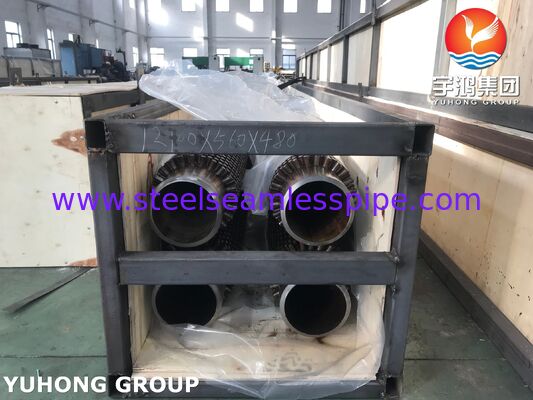
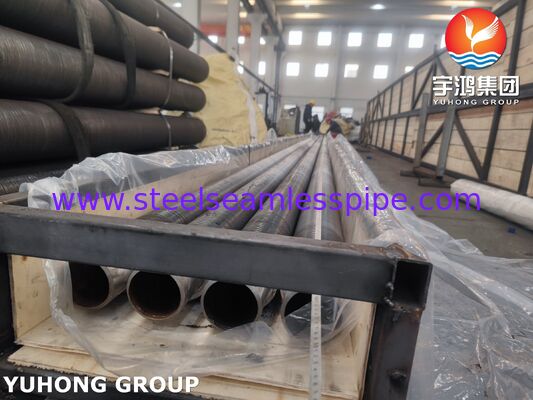
To protect the serrated fin tubes during transportation and storage, we provide packaging solutions according to product dimensions and shipping requirements.
Available packaging options include:
Steel frames for heavy-duty industrial transportation.
Wooden boxes for export shipments.
Protective end caps to prevent contamination.
Moisture-resistant wrapping where required.
Customized bundles according to tube length and customer requirements.
Each bundle can be marked with material grade, dimensions, quantity, heat number, and purchase order information for easy identification and traceability.
We focus on manufacturing high-quality finned tubes for industrial heat exchangers, fired heaters, boilers, and waste heat recovery equipment.
Our advantages include:
Experienced manufacturing of industrial finned tubes.
Strict raw material traceability.
Customized fin geometry and tube dimensions.
Qualified fin-welding procedures.
Comprehensive inspection and testing.
Project-specific technical support.
Export-oriented packaging and delivery.
Inspection documentation according to customer requirements.
We aim to provide reliable serrated fin tubes that meet demanding industrial operating conditions while supporting improved heat-transfer efficiency and equipment service life.
Q1: What is ASME SA335 P9 material?
ASME SA335 P9 is a seamless ferritic alloy-steel pipe grade containing approximately 9% chromium and 1% molybdenum. It is designed for high-temperature pressure applications.
Q2: What are serrated fin tubes used for in fired heaters?
They are mainly installed in convection sections to increase heat-transfer surface area and recover thermal energy from hot flue gases.
Q3: What is the difference between serrated and solid fin tubes?
Serrated fin tubes have segmented fins with gaps, promoting gas flow and turbulence. Solid fin tubes have continuous fins and offer a different balance of heat transfer, pressure drop, and mechanical characteristics.
Q4: Can serrated fin tubes be manufactured with customized dimensions?
Yes. Tube diameter, wall thickness, fin height, fin thickness, fin pitch, and overall length can be manufactured according to customer drawings.
Q5: Are P9 serrated fin tubes suitable for high-temperature applications?
Yes, P9 is a chromium-molybdenum alloy steel developed for high-temperature service. Final suitability must be verified against design temperature, pressure, corrosion conditions, and applicable engineering codes.
Q6: What inspection documents can be supplied?
Depending on the purchase order, we can provide material certificates, chemical analysis reports, mechanical test reports, dimensional inspection reports, NDT reports, and final inspection documentation.
Contact Person: Nancy
Tel: +8619965117039
Fax: 0086-574-88017980