Yuhong Holding Group Co.,LTD
 |
| Place of Origin: | China |
| Brand Name: | YUHONG |
| Certification: | ABS, GL, DNV, NK, PED, AD2000, GOST9941-81, CCS, ISO 9001-2015 |
| Model Number: | ASME SB163 UNS N08825 |
| Minimum Order Quantity: | 500kgs |
|---|---|
| Price: | Negotiable |
| Packaging Details: | Ply-wooden Case /Iron Case/ Bundle with plastic Cap |
| Delivery Time: | Depend on quantity |
| Payment Terms: | L/C,T/T |
| Supply Ability: | 1000 tons per month |
| Highlight: | Inconel 825 seamless tube,N08825 nickel alloy tube,ASME SB163 chemical processing tube |
||
|---|---|---|---|
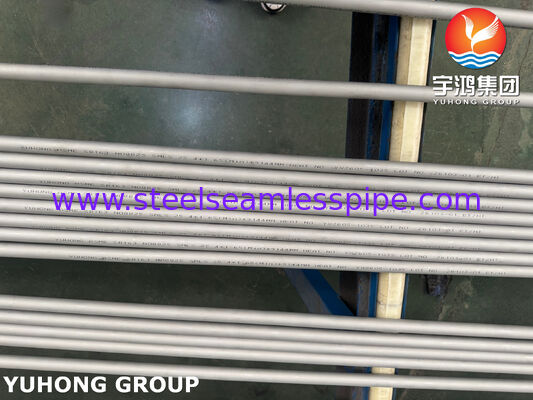
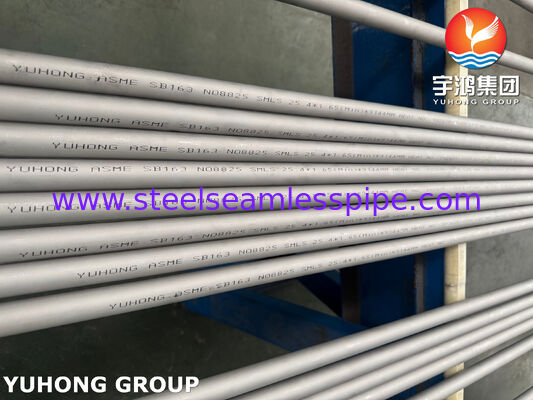
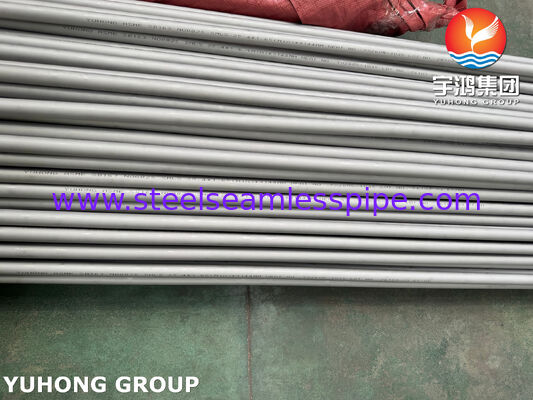
ASME SB163 UNS N08825 Incoloy 825 Seamless Tube for Chemical Processing Industry
ASME SB163 UNS N08825 Incoloy 825 Seamless Tube is a nickel-iron-chromium alloy tubing product engineered for chemical processing environments where conventional stainless steel materials may experience accelerated corrosion, localized metal loss, or premature service failure. Manufactured from Alloy 825, this seamless tube combines a high nickel content with chromium, molybdenum, copper, and titanium to provide resistance to a broad range of aggressive chemical media, particularly sulfuric acid, phosphoric acid, and chloride-containing
process solutions.
In chemical manufacturing facilities, piping and tubing systems are frequently exposed to fluctuating acid concentrations, elevated operating temperatures, chloride contamination, and continuous contact with corrosive process fluids. These conditions can contribute to general corrosion, pitting, crevice corrosion, and chloride-induced stress corrosion cracking. Selecting an appropriate alloy is therefore essential for maintaining equipment integrity, reducing unplanned maintenance, and extending the operating life of critical process systems.
Incoloy 825 seamless tubing is particularly suitable for chemical transfer lines, acid circulation systems, chemical injection tubing, heat exchanger tube bundles, condensers, evaporator systems, and process equipment handling corrosive liquids. Its nickel content contributes to resistance against chloride-induced stress corrosion cracking, while molybdenum and copper improve its resistance in reducing acid environments. Chromium provides additional protection in oxidizing conditions, and titanium helps stabilize the alloy against sensitization and associated intergranular corrosion during appropriate thermal processing and fabrication.
For sulfuric acid production units and acid handling facilities, UNS N08825 tubing can be specified for selected process lines and heat transfer equipment where corrosion resistance is a primary material selection requirement. In phosphoric acid processing, fertilizer manufacturing, and chemical concentration systems, the alloy offers a suitable material option for equipment exposed to corrosive acidic solutions, subject to actual acid concentration, temperature, impurities, and flow conditions.
Unlike welded tubing, the seamless manufacturing process eliminates the longitudinal weld seam, making the product suitable for applications where uniform wall integrity, dimensional consistency, and pressure containment are important. The tube is supplied in accordance with ASME SB163, covering seamless nickel and nickel alloy condenser and heat-exchanger tubes. The standard addresses dimensional requirements, chemical composition, mechanical properties, and applicable inspection and testing requirements.
Each production batch can be supplied with material traceability, heat number identification, dimensional inspection records, chemical analysis, mechanical test results, and an EN 10204 3.1 inspection certificate when agreed in the purchase order. Additional inspection requirements, including positive material identification (PMI), eddy current testing, ultrasonic testing where applicable, and third-party inspection, can be arranged according to project specifications.
Available supply options include customized outside diameters, wall thicknesses, cut lengths, and delivery conditions to meet the engineering requirements of chemical processing plants, industrial heat exchangers, acid production facilities, and other corrosion-intensive applications.
The primary advantage of Incoloy 825 seamless tubing is its ability to address corrosion-related material challenges in demanding chemical environments, helping equipment operators reduce tube replacement frequency, minimize leakage risks, and maintain more reliable process operation when the alloy is correctly selected for the service conditions.
Incoloy 825 seamless tubes are designed for chemical processing systems in which corrosion resistance, long-term material stability, and reliable fluid containment are essential.
Sulfuric Acid Production & Handling Systems
Used in selected sulfuric acid circulation lines, acid transfer systems, heat exchangers, and process equipment. The nickel, molybdenum, and copper content helps resist corrosion in many sulfuric acid environments.
Phosphoric Acid & Fertilizer Production
Suitable for selected phosphoric acid processing equipment, fertilizer production systems, and corrosive liquid transfer applications where conventional stainless steel may not provide sufficient service life.
Chemical Heat Exchangers & Condensers
Used in shell-and-tube heat exchangers, condensers, and other thermal processing equipment exposed to corrosive cooling water or process fluids. The seamless tube construction supports consistent tube-wall integrity.
Evaporation & Chemical Concentration Systems
Applied in selected evaporator and concentration equipment where increasing chemical concentration and operating temperature can intensify corrosion risks.
Chemical Injection & Dosing Systems
Suitable for chemical injection tubing, dosing lines, and process fluid distribution systems handling corrosive additives and treatment chemicals, subject to pressure and chemical compatibility requirements.
|
Common operating problem |
Material advantage of Incoloy 825 |
|---|---|
|
Sulfuric acid corrosion |
Molybdenum and copper improve resistance in many reducing acid environments. |
|
Phosphoric acid exposure |
Nickel-based alloy chemistry provides resistance in selected phosphoric acid applications. |
|
Chloride-induced stress corrosion cracking |
High nickel content provides improved resistance compared with conventional austenitic stainless steels. |
|
Pitting and crevice corrosion |
Chromium and molybdenum improve resistance to localized corrosion. |
|
Corrosion during thermal processing |
Titanium stabilization helps reduce susceptibility to intergranular corrosion associated with sensitization. |
|
Premature tube replacement |
Appropriate alloy selection can extend service intervals and reduce maintenance-related downtime. |
Actual corrosion performance must be evaluated against the exact chemical composition, concentration, temperature, pressure, impurities, and flow velocity. No alloy should be considered universally corrosion-proof.
|
Item |
Specification |
|---|---|
|
Product standard |
ASME SB163 |
|
Corresponding ASTM standard |
ASTM B163 |
|
Material designation |
UNS N08825 |
|
Commercial material name |
Incoloy 825 / Alloy 825 |
|
Material classification |
Nickel-Iron-Chromium-Molybdenum-Copper Alloy |
|
Manufacturing process |
Seamless |
|
Product form |
Straight seamless tube |
|
Delivery condition |
Annealed |
|
Dimensional basis |
Outside diameter and average wall or minimum wall |
|
Inspection documentation |
Mill Test Certificate (MTC) |
|
Certificate format |
EN 10204 Type 3.1, when ordered and agreed |
Important standard distinction:
ASME SB163 is the applicable product specification for seamless nickel alloy condenser and heat-exchanger tubes. ASTM B163 is its corresponding ASTM specification.
For larger-diameter nickel alloy seamless pipes, ASTM B423 / ASME SB423 may be the more appropriate specification. SB163 should not be used indiscriminately for every diameter or pipe application.
|
Parameter |
Technical Details |
|---|---|
|
Product name |
Incoloy 825 Seamless Tube |
|
Standard |
ASME SB163 / ASTM B163 |
|
UNS number |
N08825 |
|
Alloy designation |
Alloy 825 |
|
Material type |
Nickel-iron-chromium alloy |
|
Manufacturing method |
Cold drawn / seamless manufacturing route |
|
Tube shape |
Round |
|
Outside diameter |
Customized |
|
Wall thickness |
Customized |
|
Length |
Random length / fixed length / cut-to-length |
|
Surface finish |
Annealed and pickled / bright annealed, as agreed |
|
End finish |
Plain end |
|
Heat treatment |
Solution annealed / annealed condition as required by the specification |
|
Marking |
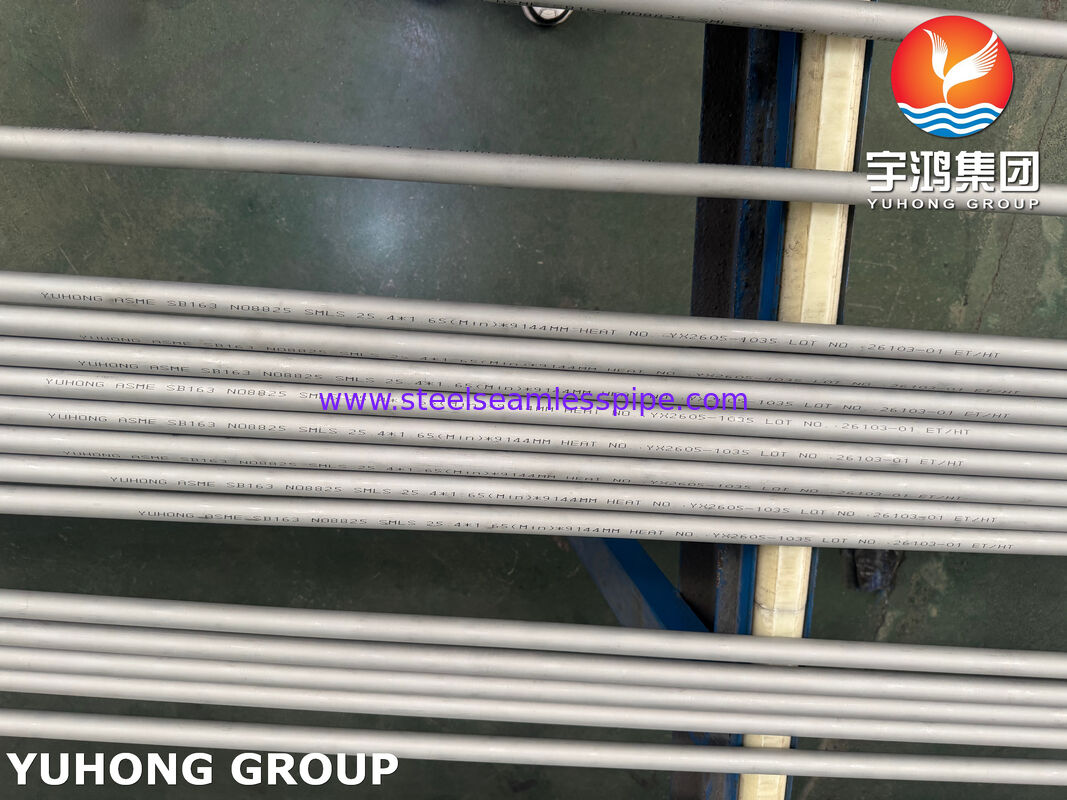
Standard, grade, dimensions, heat number, manufacturer identification |
Cold drawing is a manufacturing option, not a substitute for the required final heat-treatment condition.
The following table is a representative supply range for seamless tubing. Actual dimensions, tolerances, and availability must be confirmed against the applicable SB163 edition and the purchase specification.
|
Outside Diameter (mm) |
Outside Diameter (inch) |
Common Wall Thickness (mm) |
|---|---|---|
|
6.35 |
1/4" |
0.71–1.65 |
|
9.53 |
3/8" |
0.89–2.11 |
|
12.70 |
1/2" |
0.89–2.77 |
|
15.88 |
5/8" |
1.00–3.05 |
|
19.05 |
3/4" |
1.24–3.96 |
|
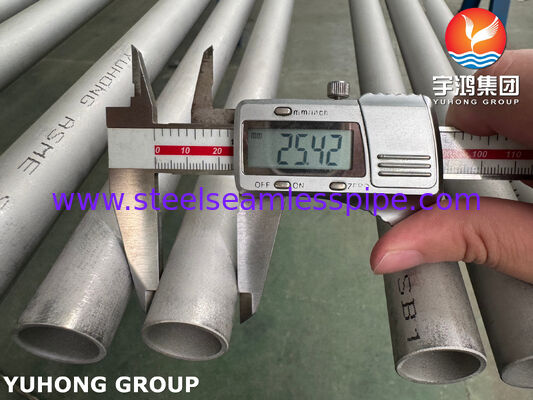
25.40 |
1" |
1.24–4.19 |
|
31.75 |
1-1/4" |
1.65–4.19 |
|
38.10 |
1-1/2" |
2.11–4.19 |
|
50.80 |
2" |
2.77–4.19 |
|
63.50 |
2-1/2" |
3.05–4.19 |
|
76.20 |
3" |
3.76–4.19 |
Note: This is an illustrative commercial dimension selection, not a complete ASTM dimensional table. ASTM B163 scope covers tubes up to 3 inches (76.2 mm) OD, with maximum specified wall limits depending on whether average-wall or minimum-wall dimensions are ordered. Some combinations in this illustrative table may require confirmation of standard applicability and manufacturing feasibility.
Dimensional acceptance should be based on the ordering requirements and applicable tables in the specified edition of ASTM B163 / ASME SB163.
Typical inspection items include:
Outside diameter tolerance
Wall thickness tolerance
Overall length tolerance
Ovality and out-of-roundness
Straightness
Surface condition
End squareness
For heat exchanger applications, consistent outside diameter and wall thickness are particularly important because they affect tube-to-tubesheet fitting, heat transfer performance, and equipment assembly.
|
Element |
Chemical Symbol |
Composition (%) |
|---|---|---|
|
Nickel |
Ni |
38.00–46.00 |
|
Chromium |
Cr |
19.50–23.50 |
|
Iron |
Fe |
22.00 min |
|
Molybdenum |
Mo |
2.50–3.50 |
|
Copper |
Cu |
1.50–3.00 |
|
Titanium |
Ti |
0.60–1.20 |
|
Manganese |
Mn |
1.00 max |
|
Silicon |
Si |
0.50 max |
|
Carbon |
C |
0.05 max |
|
Sulfur |
S |
0.03 max |
|
Aluminum |
Al |
0.20 max |
Values are nominal specification limits for UNS N08825. The applicable standard edition and material certificate govern acceptance. Fe is subject to the specified minimum, with the remaining composition determined by the alloy requirements.
|
Alloying Element |
Main Function in Chemical Processing |
|---|---|
|
Nickel (Ni) |
Improves resistance to reducing environments and chloride-induced stress corrosion cracking. |
|
Chromium (Cr) |
Supports passive film formation and resistance to oxidizing environments. |
|
Molybdenum (Mo) |
Improves resistance to pitting, crevice corrosion, and reducing acids. |
|
Copper (Cu) |
Enhances resistance to sulfuric and phosphoric acid environments. |
|
Titanium (Ti) |
Stabilizes the alloy and reduces susceptibility to intergranular corrosion after suitable thermal processing. |
|
Iron (Fe) |
Forms the alloy matrix and contributes to the overall material structure. |
The combined alloying elements make UNS N08825 a suitable choice for selected chemical process environments where both reducing and oxidizing corrosion conditions may occur.
|
Mechanical Property |
Requirement |
|---|---|
|
Tensile Strength |
586 MPa min |
|
Yield Strength (0.2% Offset) |
241 MPa min |
|
Elongation |
30% min |
|
Hardness |
As required by applicable specification and order |
These are the commonly specified minimum tensile, yield, and elongation values for annealed Alloy 825 tubing. Final acceptance must follow the applicable SB163 requirements and test specimen provisions.
|
Property |
Typical Value |
|---|---|
|
Density |
8.14 g/cm³ |
|
Melting Range |
Approximately 1370–1400°C |
|
Elastic Modulus |
Approximately 196 GPa |
|
Thermal Conductivity |
Approximately 11.1 W/m·K |
|
Electrical Resistivity |
Approximately 1.13 μΩ·m |
Physical properties are typical reference values, not guaranteed SB163 acceptance requirements. Actual values may vary with temperature and material condition.
For chemical processing applications, inspection is important not only for verifying the material grade but also for confirming dimensional consistency, internal soundness, and the condition of the finished tube.
|
Inspection / Test |
Abbreviation |
Purpose |
|---|---|---|
|
Chemical Composition Analysis |
OES / Laboratory Analysis |
Confirms alloy chemistry against UNS N08825 requirements. |
|
Positive Material Identification |
PMI |
Verifies alloy identification and helps prevent material mix-ups. |
|
Tensile Test |
TST |
Checks tensile strength, yield strength, and elongation. |
|
Hardness Test |
HT |
Evaluates material hardness when required. |
|
Eddy Current Testing |
ECT |
Detects relevant surface and near-surface discontinuities in tubing. |
|
Ultrasonic Testing |
UT |
Evaluates internal or volumetric discontinuities where applicable. |
|
Hydrostatic Test |
HST |
Checks pressure integrity where specified and applicable. |
|
Dimensional Inspection |
DI |
Verifies OD, wall thickness, length, ovality, and straightness. |
|
Visual Inspection |
VT |
Checks surface defects, finish, and visible manufacturing irregularities. |
|
Metallographic / Grain Size Examination |
MGE |
Evaluates microstructure or grain size when required. |
Inspection note: Not every test above is automatically mandatory for every SB163 order. Testing methods, sampling frequency, acceptance criteria, and supplementary examinations should be defined by the applicable standard, contract, and purchaser requirements.
Each supplied batch can be supported by the following documentation, subject to the agreed inspection plan:
EN 10204 3.1 Material Test Certificate.
Chemical composition test report.
Mechanical property test report.
Heat treatment records, where applicable.
Dimensional inspection report.
Non-destructive testing reports, when specified.
PMI report, when specified.
Third-party inspection report, when arranged.
Product identification can include:
|
Marking Item |
Description |
|---|---|
|
Manufacturer |
Manufacturer's name or identification |
|
Standard |
ASME SB163 |
|
Material Grade |
UNS N08825 |
|
Product Type |
Seamless Tube |
|
Size |
OD × WT |
|
Heat Number |
Traceability identification |
|
Quantity |
Number of tubes or bundle quantity |
All identification and traceability requirements should be agreed before production and shipment.
在化工厂项目中,材料选择往往取决于酸液种类,浓度,温度以及氯离子含量.以下对照有助于采购人员和工程人员进行初步选材.
|
Comparison |
304L |
316L |
904L |
Incoloy 825 |
|---|---|---|---|---|
|
Material Type |
Stainless Steel |
Stainless Steel |
Super Austenitic Stainless Steel |
Nickel Alloy |
|
Nickel Content |
8–12% |
10–14% |
约23–28% |
38–46% |
|
Chromium |
18–20% |
16–18% |
19–23% |
19.5–23.5% |
|
Molybdenum |
— |
2–3% |
4–5% |
2.5–3.5% |
|
Copper |
— |
— |
1–2% |
1.5–3% |
|
Chloride SCC Resistance |
Limited |
Better than 304L |
Good |
Good |
|
Sulfuric Acid Resistance |
Limited |
Limited |
Application-dependent |
Good in many suitable conditions |
|
Phosphoric Acid Resistance |
Limited |
Limited |
Application-dependent |
Suitable for selected conditions |
|
Typical Application |
General Processing |
Chemical Equipment |
Acid Handling |
Corrosive Chemical Processing |
The comparison is qualitative, not a universal corrosion ranking. Actual resistance depends on chemical concentration, temperature, impurities, and operating conditions. Chemical compatibility testing and corrosion data should be reviewed before final selection.
Higher nickel content compared with conventional stainless steel grades.
Improved resistance to chloride-induced stress corrosion cracking.
Good resistance to many sulfuric acid and phosphoric acid environments.
Molybdenum and copper contribute to resistance in reducing chemical media.
Suitable for selected applications involving both oxidizing and reducing conditions.
Seamless construction eliminates the longitudinal weld seam.
Can be supplied with material traceability and project-specific inspection documentation.
The manufacturing process of ASME SB163 UNS N08825 seamless tubes is controlled to achieve the required chemical composition, mechanical properties, dimensional accuracy, and surface quality.
Main production stages:
Raw Material Selection
Select qualified nickel alloy raw material with verified UNS N08825 chemical composition.
Billet Preparation
Inspect and prepare the alloy billet for seamless tube production.
Hot Forming / Piercing
Form the billet into a hollow tube shell using a suitable seamless manufacturing process.
Cold Drawing / Cold Working
Reduce the outside diameter and wall thickness to achieve the specified dimensions and surface finish.
Heat Treatment
Apply the required annealing treatment to achieve the specified metallurgical condition and mechanical properties.
Pickling / Surface Treatment
Remove oxide scale and surface contaminants where applicable.
Final Inspection
Perform chemical, mechanical, dimensional, and specified non-destructive examinations.
Marking & Packaging
Apply product identification and prepare the tubes for export shipment.
To protect the tube surface and maintain dimensional integrity during international transportation, appropriate export packaging can be arranged.
Plastic end caps to protect tube ends.
Protective wrapping against moisture and contamination.
Bundled packaging for standard straight tubes.
Wooden boxes for smaller diameter or precision tubing.
Heat number and product identification labels.
Seaworthy export packaging according to customer requirements.
Available delivery arrangements include standard lengths and customized cut-to-length supply, subject to manufacturing capability and order requirements.
Q1: What is the main application of ASME SB163 UNS N08825 seamless tube?
It is mainly used in chemical processing equipment, sulfuric acid handling systems, phosphoric acid production facilities, chemical heat exchangers, condensers, and other industrial systems exposed to corrosive chemical media.
Q2: Is Incoloy 825 suitable for sulfuric acid service?
Yes. Incoloy 825 offers good resistance to many sulfuric acid environments due to its nickel, molybdenum, and copper content. However, the appropriate grade must be evaluated according to acid concentration, temperature, aeration, impurities, and flow conditions.
Q3: What is the difference between ASTM B163 and ASME SB163?
ASTM B163 is the ASTM specification for seamless nickel and nickel alloy condenser and heat-exchanger tubes. ASME SB163 is the corresponding ASME specification. The edition and additional requirements specified in the project documents should be checked before ordering.
Q4: Can Incoloy 825 seamless tubes be used in heat exchangers?
Yes. ASME SB163 specifically covers seamless nickel alloy condenser and heat-exchanger tubes. Incoloy 825 is suitable for selected heat exchanger applications where resistance to corrosive process fluids is required.
Q5: What inspection documents can be supplied?
Depending on the purchase order, documentation can include an EN 10204 3.1 material certificate, chemical composition report, mechanical test report, dimensional inspection report, heat treatment records, and specified NDT reports.
Q6: Can customized dimensions be supplied?
Yes. Outside diameter, wall thickness, and length can be discussed according to project drawings and technical specifications, subject to the applicable standard and manufacturing feasibility.
Q7: What is the difference between Incoloy 825 seamless tube and Incoloy 825 seamless pipe?
The main distinction is the applicable product specification and dimensional classification. ASTM B163 / ASME SB163 covers seamless condenser and heat-exchanger tubes, while ASTM B423 / ASME SB423 covers seamless nickel alloy pipe. The correct specification should be selected according to the intended product and application.
Contact Person: Mr. Jikin Cai
Tel: +86-13819835483
Fax: 0086-574-88017980