Yuhong Holding Group Co.,LTD
 |
| Place of Origin: | China |
| Brand Name: | YUHONG |
| Certification: | ISO9001:2015; ISO14001:2015; ISO45001:2018; PED 2014/68/EU; WPS/PQR/WPQ; ISO 3834 |
| Model Number: | N/A |
| Minimum Order Quantity: | 500kgs |
|---|---|
| Price: | To be discussed |
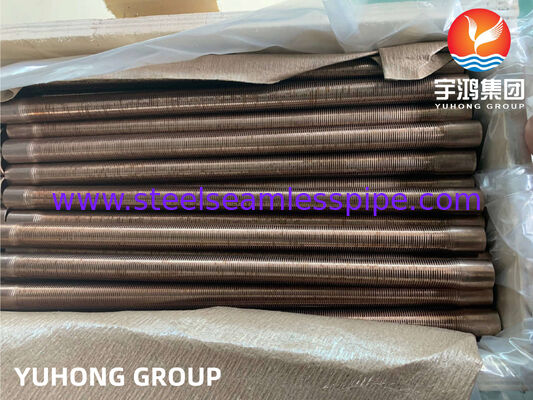
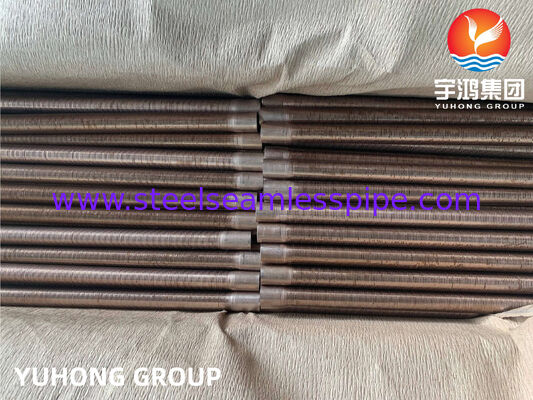
| Packaging Details: | Plywood case |
| Delivery Time: | 50-120 days |
| Payment Terms: | L/C,T/T |
| Supply Ability: | 5000 meters/day |
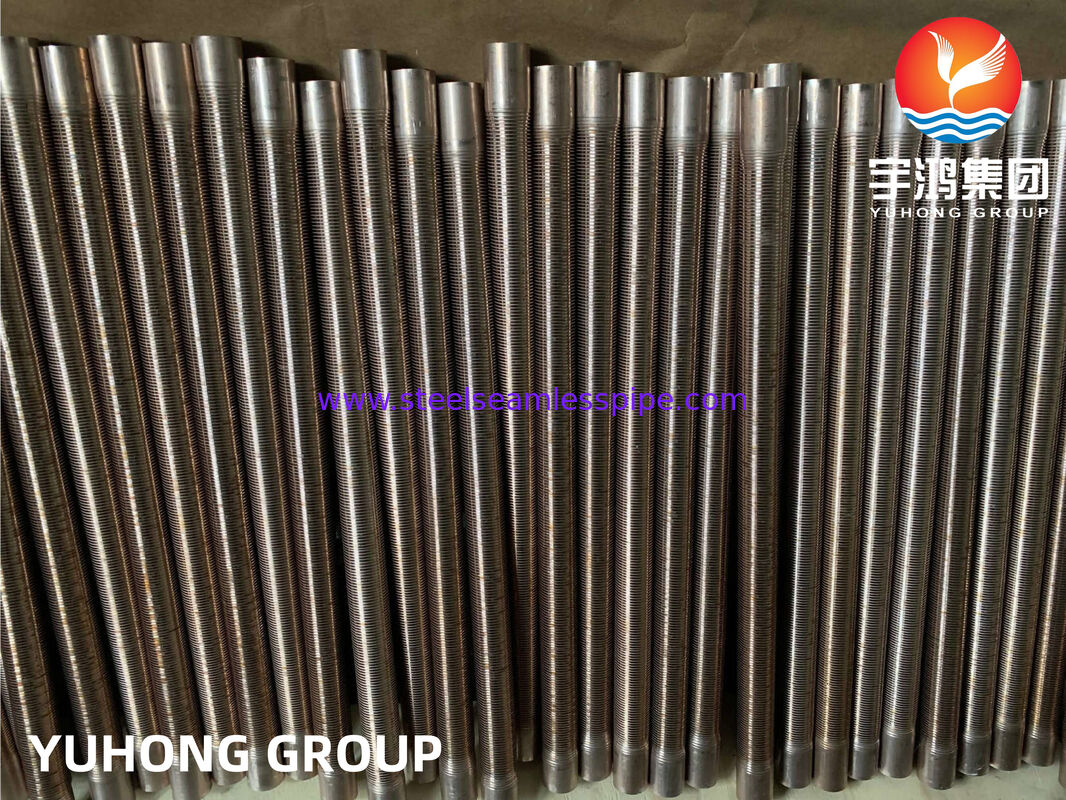
| Product: | Low Fin Tube | Material: | ASTM B111 C70600 |
|---|---|---|---|
| Application: | Power Plate Condenser | Package: | Plywood Case |
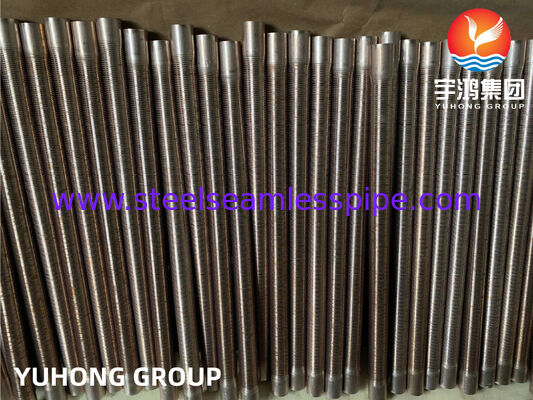
Low fin tubes for power plant condensers, manufactured from ASME SB111 C70600 copper-nickel alloy, are specially engineered heat-transfer tubes designed to improve condenser efficiency and thermal performance in power generation facilities.
C70600, commonly known as 90/10 copper-nickel, contains approximately 90% copper and 10% nickel, with controlled iron and manganese additions. This alloy is widely used in condenser and heat-exchanger applications because of its excellent resistance to seawater corrosion, good thermal conductivity, and reliable mechanical properties.
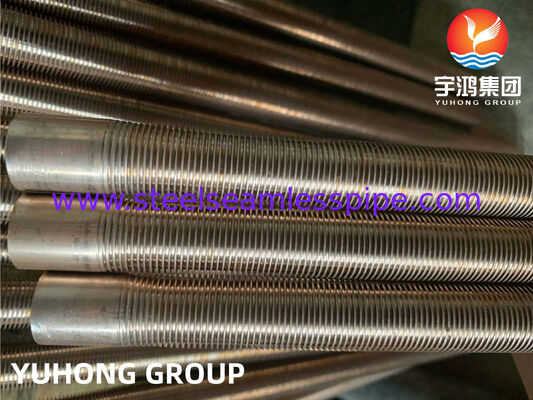
Low fin tubes feature closely spaced, shallow fins formed directly from the external tube wall through a precision rolling process. Compared with conventional smooth tubes, the increased external surface area enhances heat transfer, particularly on the steam-condensing side of power plant condensers.
Our low fin tubes combine the corrosion-resistant characteristics of C70600 copper-nickel alloy with precision-formed fin geometry to provide reliable heat-transfer performance in demanding power station environments.
Product specifications
|
Item |
Description |
|---|---|
|
Product name |
Low Fin Tubes for Power Plant Condensers |
|
Material standard |
ASME SB111 / ASTM B111 |
|
Material grade |
C70600 |
|
UNS designation |
UNS C70600 |
|
Alloy type |
90/10 Copper-Nickel |
|
Tube manufacturing |
Seamless |
|
Fin manufacturing |
Integral mechanical rolling |
|
Fin configuration |
External low-profile helical fins |
|
Typical temper |
O61 Annealed |
|
Main application |
Power plant surface condensers |
|
Other applications |
Marine condensers, evaporators, and industrial heat exchangers |
Important standard clarification: The correct designation is ASME SB111 (or ASTM B111), rather than ASME B111. SB111 covers seamless copper and copper-alloy condenser tubes and ferrule stock, including C70600. The low-fin geometry and dimensional requirements should be specified separately.
1. Excellent seawater corrosion resistance
C70600 copper-nickel alloy provides good resistance to seawater corrosion and is particularly suitable for condenser systems using seawater or other compatible cooling water.
2. Enhanced heat-transfer performance
The low-profile external fins increase the effective heat-transfer area, helping improve thermal exchange compared with smooth tubes of similar nominal dimensions.
3. Good resistance to marine biofouling
Copper-nickel alloys have useful resistance to marine biological fouling under suitable operating conditions, helping support reliable condenser operation.
4. Strong mechanical properties
The 90/10 copper-nickel alloy provides a practical combination of tensile strength, ductility, and pressure-bearing capability.
5. Integral fin construction
The fins are formed directly from the tube wall through mechanical rolling, avoiding a separate fin-to-tube weld or mechanical joint.
6. Reliable thermal performance
Copper-nickel offers good thermal conductivity and stable performance in properly designed condenser cooling systems.
7. Long service potential
When correctly selected and operated, C70600 tubes can provide reliable service in power plant condensers, including applications exposed to seawater cooling.
Low fin tubes manufactured from C70600 copper-nickel are particularly suitable for condenser and heat-exchanger applications where corrosion resistance and heat-transfer efficiency are important.
|
Application |
Main function |
|---|---|
|
Power plant surface condensers |
Condenses exhaust steam from steam turbines |
|
Thermal power stations |
Improves condenser heat-transfer performance |
|
Nuclear power plant condensers |
Supports selected condenser cooling-water systems |
|
Marine condensers |
Provides heat exchange in seawater environments |
|
Industrial steam condensers |
Transfers heat from condensing steam to cooling water |
|
Evaporators |
Provides an enlarged heat-transfer surface |
|
Desalination equipment |
Supports selected seawater heat-transfer applications |
|
Industrial heat exchangers |
Improves thermal performance in compatible process conditions |
Main application: Power plant surface condensers, where exhaust steam condenses on the external tube surface while cooling water flows through the tube interior.
Low fin tubes can be manufactured in different dimensions according to condenser design, heat-transfer calculations, and customer drawings.
The following are indicative commercial manufacturing ranges, not mandatory dimensions established by ASME SB111.
|
Parameter |
Typical specifications |
|---|---|
|
Base tube outside diameter |
12.7–25.4 mm |
|
Base tube wall thickness |
0.7–2.0 mm |
|
Tube length |
3,000–18,000 mm |
|
Fin height |
0.5–1.5 mm |
|
Fin thickness |
0.2–0.5 mm |
|
Fin pitch |
0.5–1.5 mm |
|
Fin density |
16–40 fins per inch |
|
Fin type |
Integral helical low fins |
|
Base tube material |
C70600 copper-nickel |
|
Manufacturing process |
Mechanical fin rolling |
|
Temper |
O61 annealed or as specified |
|
Tube ends |
Plain, un-finned ends as required |
Available customization:
Different base tube diameters and wall thicknesses.
Customized fin height and fin density.
Different fin pitches according to condenser design.
Customized tube lengths and un-finned end sections.
Specific wall thickness tolerances.
Special requirements for seawater-cooled condenser systems.
The final tube dimensions should be confirmed through the condenser manufacturer's drawings and thermal design calculations.
C70600 is a 90/10 copper-nickel alloy developed for condenser tubing, marine heat exchangers, and industrial cooling systems.
Its copper-nickel composition, combined with controlled iron and manganese additions, provides good resistance to seawater corrosion, erosion-corrosion, and general marine service conditions.
The following table presents the chemical composition requirements for C70600 under ASTM B111 / ASME SB111.
|
Chemical element |
Composition (wt.%) |
|---|---|
|
Copper (Cu), including silver |
Remainder |
|
Nickel (Ni), including cobalt |
9.0–11.0 |
|
Iron (Fe) |
1.0–1.8 |
|
Manganese (Mn) |
≤ 1.0 |
|
Zinc (Zn) |
≤ 1.0 |
|
Lead (Pb) |
≤ 0.05 |
|
Copper plus specified elements |
≥ 99.5 |
Material characteristics:
Copper: Provides good thermal conductivity and corrosion resistance.
Nickel: Improves mechanical strength and corrosion resistance.
Iron: Enhances resistance to erosion-corrosion, particularly in flowing seawater.
Manganese: Contributes to alloy strength and metallurgical stability.
Zinc and lead: Controlled to maintain the required alloy quality.
The exact composition should be verified against the applicable edition of ASME SB111 and the material test certificate supplied with each production batch.
The mechanical properties of C70600 depend on the material temper and manufacturing condition. O61 annealed temper is commonly selected for condenser tubing because it provides good ductility and formability.
The following table gives typical minimum requirements for C70600 O61 annealed tubing.
|
Mechanical property |
Requirement |
|---|---|
|
Tensile strength |
≥ 275 MPa |
|
Yield strength (0.5% extension under load) |
≥ 105 MPa |
|
Elongation |
≥ 30% |
|
Temper |
O61 – Annealed |
|
Density (typical) |
Approximately 8.94 g/cm³ |
Mechanical performance advantages:
Good tensile strength for condenser tube applications.
High ductility in the annealed condition.
Suitable formability for mechanical low-fin rolling.
Good resistance to deformation under appropriate operating conditions.
Reliable performance in properly designed heat-exchanger systems.
The specified mechanical properties apply to the base tube in the relevant temper. The finished low-fin tube should also be evaluated for wall-thickness reduction, fin geometry, and dimensional integrity after rolling.
Our low fin tubes are manufactured using precision mechanical rolling technology to produce uniform external fins directly from the C70600 copper-nickel tube wall.
Step 1 – Raw material selection
Seamless C70600 copper-nickel tubes are selected according to the required outside diameter, wall thickness, length, and temper. Material certificates are checked before production.
Step 2 – Base tube preparation
The tube surface is cleaned and inspected to ensure that it is free from unacceptable scratches, dents, and other defects that could affect the finning operation.
Step 3 – Mechanical fin rolling
The tube passes through specialized finning rollers. The external tube material is displaced and formed into continuous helical low fins without adding separate fin strips.
Step 4 – Fin geometry control
Fin height, pitch, thickness, and overall profile are controlled to ensure uniform heat-transfer geometry along the tube length.
Step 5 – Dimensional adjustment
The finished tubes are checked for outside diameter, straightness, fin dimensions, and un-finned end lengths.
Step 6 – Cleaning and finishing
Tubes are cleaned to remove manufacturing residues and prepared for inspection and packaging.
Step 7 – Final quality inspection
Finished tubes undergo dimensional inspection, surface examination, material verification, and the specified nondestructive and mechanical tests.
Quality assurance is particularly important for power plant condenser tubes because they operate continuously under demanding thermal and cooling-water conditions.
Our inspection program can include the following procedures according to the purchase order and applicable standards.
|
Inspection method |
Inspection purpose |
|---|---|
|
Mill Test Certificate (MTC) review |
Confirms C70600 material grade and heat/batch traceability |
|
Chemical composition analysis |
Verifies copper, nickel, iron, manganese, and other alloying elements |
|
Tensile testing |
Checks tensile strength, yield strength, and elongation |
|
Hardness testing |
Evaluates material hardness when required |
|
Dimensional inspection |
Measures tube diameter, wall thickness, and length |
|
Fin height measurement |
Checks the consistency of fin height |
|
Fin pitch inspection |
Verifies spacing between adjacent fins |
|
Fin profile inspection |
Confirms the geometry and uniformity of rolled fins |
|
Eddy current testing |
Detects relevant tube-wall discontinuities |
|
Hydrostatic testing |
Verifies pressure integrity when required |
|
Pneumatic or air-underwater testing |
Checks leakage where specified by the purchase order |
|
Visual inspection |
Identifies scratches, cracks, dents, and surface irregularities |
|
Expansion testing |
Evaluates tube ductility and material integrity |
|
Flattening testing |
Evaluates deformation characteristics where required |
|
Residual stress testing |
Evaluates residual stresses when specified |
|
Final inspection |
Confirms overall product compliance and documentation |
Additional quality-control requirements:
Chemical analysis must comply with the specified C70600 composition limits.
Mechanical tests must correspond to the ordered temper.
Nondestructive testing should follow the applicable standard and agreed acceptance criteria.
Fin rolling must not produce unacceptable wall thinning or cracks.
The finished tube should maintain the required pressure-bearing wall thickness.
Tube ends should be checked for dimensional accuracy and suitability for condenser installation.
ASTM B111 / ASME SB111 establishes requirements for seamless condenser tubes, including applicable material and testing provisions. The finished low-fin dimensions and additional finning inspection criteria should be defined separately.
1. Improved condenser heat-transfer performance
The increased external surface area helps improve heat exchange between turbine exhaust steam and cooling water.
2. Excellent seawater compatibility
C70600 copper-nickel provides good corrosion resistance in suitable seawater condenser applications.
3. Reduced fouling tendency
The copper-nickel alloy offers useful resistance to marine biofouling, although actual fouling depends on water quality, velocity, temperature, and operating conditions.
4. Efficient equipment design
Low fin geometry can increase heat-transfer capacity within an existing condenser envelope, subject to thermal and hydraulic calculations.
5. Reliable mechanical construction
The integral fin structure eliminates separate fin attachment joints and maintains continuity with the tube wall.
6. Suitable for long-term industrial operation
When properly selected, installed, and maintained, C70600 low fin tubes provide a dependable heat-transfer solution for power generation and industrial condenser systems.
Engineering consideration: Low fin tubes are not automatically interchangeable with smooth tubes. The condenser designer must verify cooling-water pressure drop, steam-side drainage, tube expansion requirements, tube support compatibility, and the minimum remaining wall thickness after fin rolling.
To protect the copper-nickel tubes during storage and transportation, customized packaging can be provided according to customer requirements.
Protective end caps to prevent contamination and mechanical damage.
Bundled packaging with suitable supports to prevent bending.
Protective wrapping to minimize moisture and surface contamination.
Wooden cases or export-standard packaging for international transportation.
Clear identification labels showing material grade, dimensions, quantity, temper, and order number.
Customized packaging for long-distance shipping and overseas projects.
Material certificates, inspection reports, and other agreed quality documentation can be supplied with each order.
For accurate quotations and technical evaluation, customers are encouraged to provide the following information:
|
Item |
Required information |
|---|---|
|
Product |
Low fin tubes for power plant condensers |
|
Material standard |
ASME SB111 / ASTM B111 |
|
Material grade |
C70600 |
|
Alloy designation |
90/10 Copper-Nickel |
|
Temper |
O61 Annealed or as specified |
|
Base tube OD |
As per drawing |
|
Wall thickness |
As per drawing |
|
Tube length |
As required |
|
Fin height |
As required |
|
Fin pitch |
As required |
|
Fin thickness |
As required |
|
Fin density |
As required |
|
Quantity |
As per purchase order |
|
Testing requirements |
As per project specification |
|
Packaging |
Export or customized packaging |
We welcome inquiries from power plant owners, condenser manufacturers, EPC contractors, thermal power engineering companies, and industrial heat-exchanger manufacturers worldwide.
Contact Person: Nacy
Tel: +8619965117039
Fax: 0086-574-88017980