Yuhong Holding Group Co.,LTD
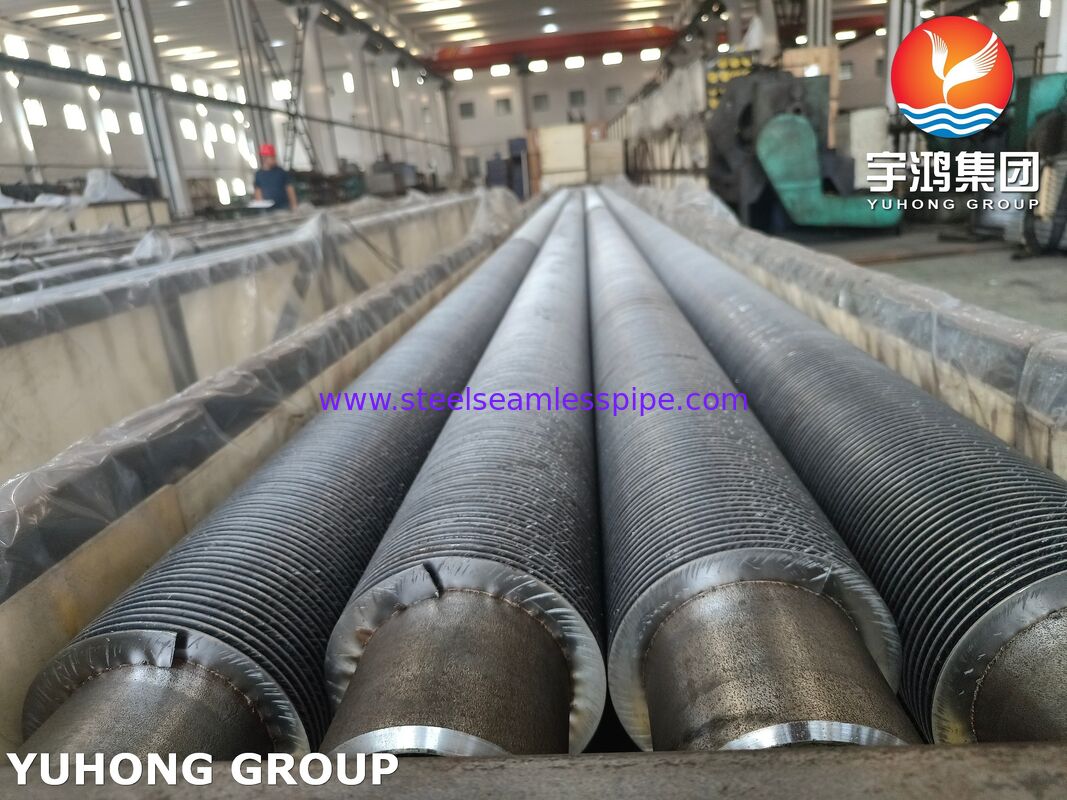 |
| Place of Origin: | China |
| Brand Name: | YUHONG |
| Certification: | ISO9001:2015; ISO14001:2015; ISO45001:2018; PED 2014/68/EU; WPS/PQR/WPQ; ISO 3834 |
| Model Number: | N/A |
| Minimum Order Quantity: | 500kgs |
|---|---|
| Price: | To be discussed |
| Packaging Details: | Iron frame wooden case |
| Delivery Time: | 50-120 days |
| Payment Terms: | L/C,T/T |
| Supply Ability: | 5000 meters/day |
| Product: | HFW Fin Tube | Material: | ASTM A335 P22 |
|---|---|---|---|
| Application: | Economizer | Package: | Iron Frame Wooden Case |
| Highlight: | ASTM A335 P22 finned tubes,HFW finned tubes for economizers,economizer fin tubes with warranty |
||
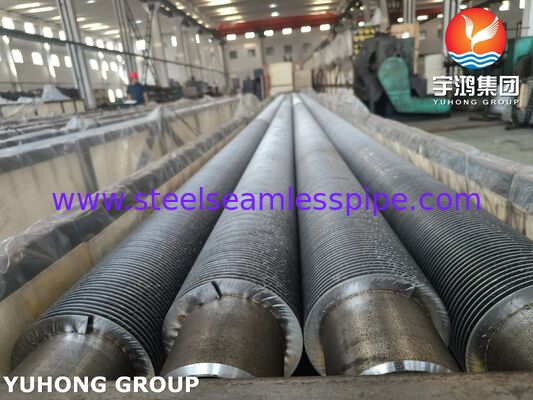
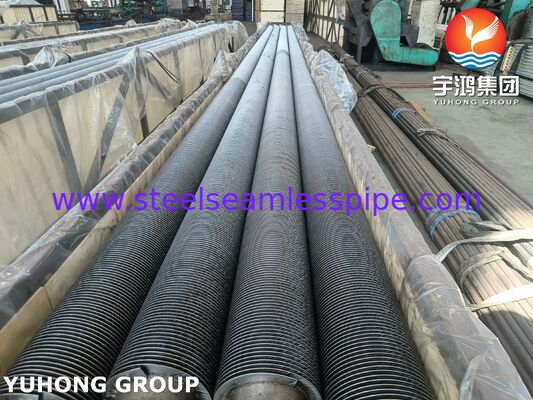
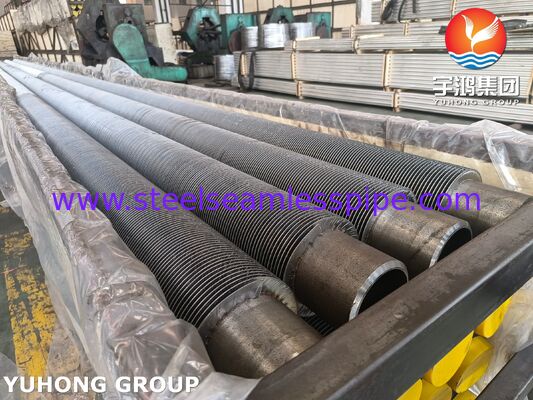
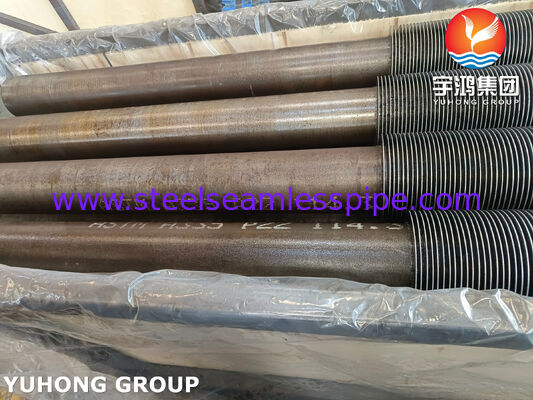
ASTM A335 P22 high-frequency welded finned tubes are engineered heat-transfer tubes designed for high-temperature economizers, boiler heat-recovery sections, HRSG systems, and industrial waste heat recovery equipment. Manufactured with a P22 alloy steel tube and continuously welded fins, these tubes provide substantially greater external heat-transfer surface area than plain tubes while maintaining reliable mechanical and thermal performance under demanding operating conditions.
ASTM A335 P22 is a chromium-molybdenum alloy steel containing approximately 2.25% chromium and 1% molybdenum. Its elevated-temperature strength, oxidation resistance, and resistance to thermal degradation make it particularly suitable for boiler and heat-recovery applications where conventional carbon-steel tubes may not provide sufficient temperature capability.
The high-frequency welding process creates a continuous metallurgical bond between the fin strip and tube surface. This provides efficient heat transfer from hot flue gas to the working fluid inside the tube while maintaining good resistance to vibration and repeated thermal cycling.
For economizer applications, P22 HFW finned tubes are primarily used to recover sensible heat from boiler exhaust gas and transfer it to feedwater or another process fluid. This reduces fuel consumption, improves boiler efficiency, and lowers the temperature of discharged flue gas.
Economizer heat-transfer performance depends heavily on the available surface area and the temperature of the flue gas. A finned tube increases the external heat-transfer area without requiring a proportional increase in tube length or equipment footprint.
The combination of ASTM A335 P22 tube material + high-frequency welded fin construction offers several advantages:
P22 is especially useful in economizer sections exposed to relatively high flue-gas temperatures or severe thermal conditions.
ASTM A335 P22 HFW finned tubes are mainly used in:
This is the principal application. The finned tubes recover heat from boiler flue gas and use it to preheat boiler feedwater before the water enters the steam-generating system.
P22 finned tubes can be used in selected high-temperature heat-recovery sections of heat recovery steam generators (HRSGs) where elevated-temperature alloy steel tubing is required.
Industrial facilities can use P22 HFW finned tubes to recover energy from hot exhaust streams generated by furnaces, process equipment, engines, turbines, and other high-temperature systems.
They are suitable for heat-transfer sections in utility and industrial power-generation equipment where high-temperature strength and reliable heat recovery are required.
Applications include refinery, petrochemical, chemical, metallurgical, and other industrial plants requiring recovery of heat from hot exhaust gases.
A P22 HFW finned tube generally consists of:
P22 alloy steel tube → high-frequency welded fin → continuous finned heat-transfer surface
The fin is continuously welded to the external tube wall using a high-frequency electrical resistance welding process. Unlike mechanically assembled fin arrangements, the welded connection provides a strong and continuous heat-transfer path between the tube and fin.
Depending on the economizer design, customers can specify different combinations of:
The final dimensions should always be established according to the economizer thermal design, pressure requirements, gas velocity, fouling conditions, and applicable project specification.
Typical tube dimensions include:
| Parameter | Common Range |
|---|---|
| Tube OD | 25–76 mm |
| Tube wall thickness | 2.5–8.0 mm |
| Finned length | 1,000–12,000 mm |
| Fin height | 8–30 mm |
| Fin thickness | 0.8–2.5 mm |
| Fin pitch | 2.5–12 mm |
| Bare tube ends | 50–300 mm or according to drawing |
Common tube diameters such as 25.4 mm, 31.8 mm, 38.1 mm, 44.5 mm, 50.8 mm, 57 mm and 63.5 mm can be manufactured depending on the customer's economizer design.
These values are representative manufacturing ranges rather than fixed ASTM A335 dimensional requirements. Exact tube and fin dimensions should be confirmed against the approved engineering drawing and purchase specification.
ASTM A335 P22 is a ferritic alloy-steel grade containing chromium and molybdenum for elevated-temperature service.
| Element | Typical ASTM A335 P22 Requirement, wt.% |
|---|---|
| Carbon (C) | 0.05–0.15 |
| Manganese (Mn) | 0.30–0.60 |
| Phosphorus (P) | ≤0.025 |
| Sulfur (S) | ≤0.025 |
| Silicon (Si) | ≤0.50 |
| Chromium (Cr) | 1.90–2.60 |
| Molybdenum (Mo) | 0.87–1.13 |
The chromium content improves oxidation and corrosion resistance at elevated temperature, while molybdenum contributes to high-temperature strength and creep resistance.
The chemical composition shown above should be verified against the applicable edition of ASTM A335/A335M and the specific material certificate supplied with the product.
Typical minimum mechanical requirements for ASTM A335 P22 include:
| Property | Requirement |
|---|---|
| Tensile strength | ≥415 MPa |
| Yield strength | ≥205 MPa |
| Elongation | ≥30% |
Actual mechanical properties may exceed the specified minimum values depending on manufacturing conditions and heat treatment.
For economizer applications, the material's elevated-temperature performance is particularly important because the tube is exposed to temperature fluctuations and pressure while transferring heat from the flue gas to the internal fluid.
The fin strip is continuously attached to the P22 tube using a high-frequency welding process.
During welding, high-frequency electrical current produces localized heating at the fin-to-tube interface. Pressure is then applied to establish a continuous welded connection.
The manufacturing process normally involves:
Correct welding parameters are essential because excessive heat input can negatively affect the tube material, while insufficient heat input can result in inadequate fin bonding.
Quality control should cover both the ASTM A335 P22 tube and the high-frequency welded fin structure.
Depending on the purchase specification and application, testing may include:
Positive material identification or laboratory chemical analysis can be used to verify the P22 alloy composition.
Tensile testing verifies tensile strength, yield strength, and elongation against the applicable material specification.
Hardness testing may be performed to verify material condition and heat-treatment consistency.
The tube may be subjected to hydrostatic testing according to the applicable ASTM specification, project requirements, or purchaser's specification.
Eddy current examination can be used to detect certain surface and near-surface discontinuities in the tube.
Ultrasonic examination may be specified for detecting internal or volumetric discontinuities in the tube material or weld region.
The welded fin connection should be examined for continuity, bonding quality, undercut, excessive weld irregularity, separation, and other defects.
Important dimensions include:
The finished tube should be visually examined for surface damage, fin deformation, incomplete welding, cracks, corrosion, excessive oxidation, and other manufacturing defects.
Testing requirements should be agreed upon before production because the applicable inspection plan depends on the customer's project specification and governing code.
The welded fins increase the external heat-transfer area, allowing the economizer to transfer more heat within a relatively compact installation.
P22 chromium-molybdenum steel provides better high-temperature performance than many conventional carbon-steel tube grades.
Continuous high-frequency welding creates a reliable connection between the fin and tube, improving heat-transfer efficiency and resistance to mechanical vibration.
The increased surface area of the finned tube allows designers to achieve the required heat-transfer duty with a more compact tube bank.
Properly manufactured HFW finned tubes can withstand repeated heating and cooling cycles encountered in boiler and waste-heat-recovery systems.
A plain tube provides heat transfer primarily through its external tube surface. In an economizer, however, the gas-side heat-transfer coefficient is often much lower than the liquid-side coefficient.
Adding fins increases the gas-side surface area and therefore helps balance the heat-transfer resistance.
This makes HFW finned tubes particularly attractive for:
Hot flue gas → fin surface → welded fin/tube interface → P22 tube wall → feedwater
The result is a more efficient use of the available heat-transfer surface.
ASTM A335 P22 HFW finned tubes are particularly appropriate for:
The final material selection should consider flue-gas temperature, feedwater temperature, pressure, corrosion environment, sulfur content, ash/fouling characteristics, thermal cycling, and design life.
P22 HFW finned tubes can be supplied according to customer drawings or engineered specifications. Depending on the project, customization can include:
Each production batch can be supplied with relevant quality documentation, such as Material Test Certificates (MTCs), dimensional inspection reports, mechanical-test results, chemical-analysis results, and applicable non-destructive testing records.
For critical boiler and heat-recovery applications, quality control should extend throughout the manufacturing process—from incoming P22 tube verification through fin welding and final inspection.
Particular attention should be given to:
This approach helps ensure that the finished finned tubes meet the technical requirements of demanding economizer applications.
ASTM A335 P22 high-frequency welded finned tubes provide a practical combination of elevated-temperature alloy-steel performance and high-efficiency finned heat transfer. Their principal application is boiler economizers, where they recover heat from hot flue gas and transfer it to boiler feedwater.
Their use can also extend to HRSGs, waste heat recovery boilers, power plants, refineries, petrochemical facilities, and industrial furnace heat-recovery systems.
For projects requiring high heat-transfer capacity, compact equipment dimensions, and reliable operation at elevated temperatures, P22 HFW finned tubes are a strong solution for economizer heat-transfer surfaces.
Contact Person: Vantin
Tel: 19537363734
Fax: 0086-574-88017980