Yuhong Holding Group Co.,LTD
 |
| Place of Origin: | China |
| Brand Name: | YUHONG |
| Certification: | ISO9001:2015; ISO14001:2015; ISO45001:2018; PED 2014/68/EU; WPS/PQR/WPQ; ISO 3834 |
| Model Number: | N/A |
| Minimum Order Quantity: | 500kgs |
|---|---|
| Price: | To be discussed |
| Packaging Details: | Iron frame wooden case |
| Delivery Time: | 50-120 days |
| Payment Terms: | L/C,T/T |
| Supply Ability: | 5000 meters/day |
| Product: | HFW Fin Tube | Material: | ASTM A269 TP321 |
|---|---|---|---|
| Application: | Waste Heat Recovery | Package: | Iron Frame Wooden Case |
| Highlight: | ASTM A269 TP321 finned tubes,HFW finned tubes for heat recovery,waste heat recovery fin tubes |
||
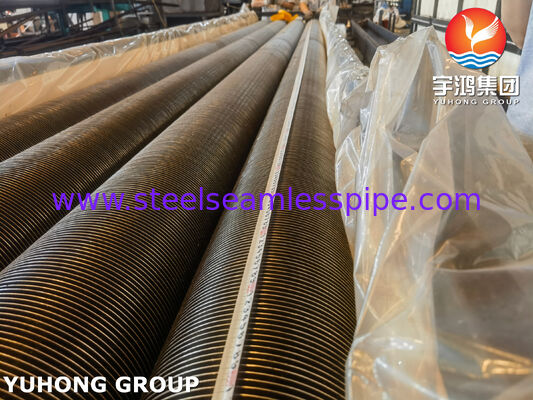
ASTM A269 TP321 High-Frequency Welded Finned Tubes are engineered heat-transfer components designed to improve thermal efficiency in waste heat recovery systems, industrial furnaces, refinery process heaters, petrochemical plants, and high-temperature gas heat exchangers.
The product combines an austenitic stainless steel TP321 tube with continuously welded metallic fins. High-frequency welding produces a strong metallurgical/mechanical bond between the fin and tube, allowing heat to transfer efficiently from hot flue gas or process gas through the finned surface and into the tube-side fluid.
ASTM A269 TP321 is particularly suitable for elevated-temperature applications where resistance to oxidation, thermal cycling, and intergranular corrosion is important. The titanium-stabilized TP321 grade can provide advantages over conventional 304 stainless steel in certain elevated-temperature services.
For waste heat recovery equipment, the finned construction increases the effective external heat-transfer area considerably compared with a bare tube. This allows equipment designers to achieve higher heat recovery within a relatively compact heat-transfer surface.
ASTM A269 TP321 HFW finned tubes are particularly suitable for:
The tubes can be incorporated into heat-recovery sections where hot exhaust gases transfer their residual energy to water or another process fluid.
Typical applications include:
Refineries and petrochemical facilities generate substantial quantities of high-temperature exhaust and process gases. TP321 HFW finned tubes can be used to recover this otherwise wasted thermal energy.
Potential applications include:
Industrial furnaces discharge hot gases containing significant recoverable energy. Finned-tube heat exchangers can capture this energy for:
The combination of TP321 stainless steel and HFW fin construction makes this product suitable for heat exchangers exposed to hot gases where a large gas-side heat-transfer surface is required.
The exact dimensions should be selected according to the heat-transfer calculation, gas velocity, operating temperature, pressure, fouling conditions and equipment design.
Typical manufacturing ranges can include:
| Item | Typical Range |
|---|---|
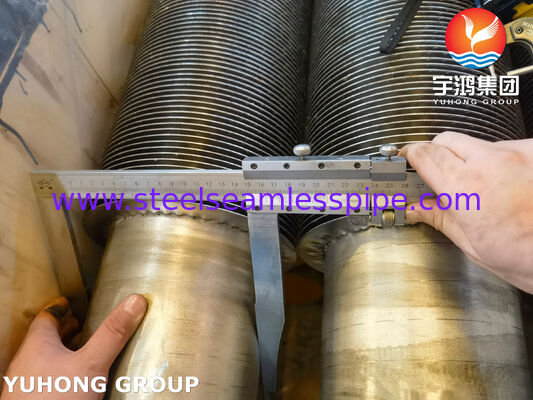
| Tube OD | 19.05–63.5 mm |
| Tube wall thickness | 1.5–5.0 mm |
| Fin height | 8–25 mm |
| Fin thickness | 0.8–2.5 mm |
| Fin pitch | 2.5–10 mm |
| Tube length | 1–15 m |
| Fin configuration | Solid or serrated, depending on design |
| Fin material | Stainless steel or compatible alloy |
| Tube material | ASTM A269 TP321 |
These are common engineering ranges rather than fixed ASTM A269 requirements. Customized dimensions can be manufactured according to customer drawings, heat-transfer calculations or equipment specifications.
For particularly demanding high-temperature service, the fin material should be selected together with the tube material based on operating temperature, corrosion environment and thermal-expansion requirements.
The following represents the commonly specified chemical composition limits for TP321 stainless steel tubing under ASTM A269. The applicable edition of the standard and the purchaser's specification should be confirmed for each order.
| Element | TP321 Typical Maximum / Range (%) |
|---|---|
| Carbon (C) | ≤ 0.08 |
| Manganese (Mn) | ≤ 2.00 |
| Silicon (Si) | ≤ 0.75 |
| Phosphorus (P) | ≤ 0.045 |
| Sulfur (S) | ≤ 0.030 |
| Chromium (Cr) | 17.0–19.0 |
| Nickel (Ni) | 9.0–12.0 |
| Titanium (Ti) | ≥ 5 × C and ≤ 0.70 |
| Iron (Fe) | Balance |
Important: The values above should be treated as the commonly specified ASTM A269 TP321 composition range. The governing material certificate and current ASTM edition should always take precedence.
Typical minimum mechanical requirements associated with ASTM A269 TP321 include:
| Property | Typical Requirement |
|---|---|
| Tensile strength | ≥ 515 MPa |
| Yield strength | ≥ 205 MPa |
| Elongation | ≥ 35% |
Actual mechanical properties can vary according to tube manufacturing condition, heat treatment, dimensions and applicable purchase specification.
For finned-tube applications, the mechanical performance of the tube itself should not be confused with fin-to-tube bond performance. The latter requires separate manufacturing and inspection controls.
The fin is continuously attached to the tube using a controlled high-frequency welding process.
During production, high-frequency electrical energy generates localized heat at the fin-to-tube interface. Controlled pressure brings the fin and tube into intimate contact, producing a continuous welded attachment.
The process provides several advantages:
The welding parameters are controlled according to tube material, fin material, fin thickness, fin height and production speed.
Quality control should cover both the ASTM A269 TP321 base tube and the finished finned tube.
PMI or laboratory chemical analysis can be performed to verify the stainless-steel grade and confirm the required alloying elements.
Representative tubes are tested for tensile strength, yield strength and elongation according to the applicable standard.
Hardness testing may be performed as required by the purchase specification or quality-control plan.
The tube can be subjected to the applicable hydrostatic test or nondestructive electric testing required by ASTM A269 and the purchase specification.
Typical dimensional checks include:
The finished finned tube is inspected for:
Because the thermal performance of an HFW finned tube depends heavily on the fin-to-tube connection, the welded region should be inspected according to the manufacturer's quality-control procedure and purchaser requirements.
Depending on the application, destructive bond testing, metallographic examination or other approved inspection methods may be specified.
A Material Test Certificate (MTC) can be supplied to document the tube material, chemical composition and mechanical properties. EN 10204 3.1 certification can also be provided when specified by the purchaser.
The principal advantage of the HFW finned configuration is the significant increase in gas-side heat-transfer surface area.
Compared with bare tubes, finned tubes can:
TP321 further provides an attractive material option when the heat-recovery system operates at elevated temperatures and requires an austenitic stainless steel with titanium stabilization.
We can manufacture ASTM A269 TP321 HFW finned tubes according to customer requirements, including customized:
For a new waste heat recovery project, customers can provide heat duty, inlet/outlet temperatures, gas composition, flow rate, operating pressure, tube-side medium and available installation space so that the finned-tube configuration can be matched to the equipment design.
Contact Person: Nacy
Tel: +8619965117039
Fax: 0086-574-88017980