Yuhong Holding Group Co.,LTD
 |
| Place of Origin: | China |
| Brand Name: | YUHONG |
| Certification: | ISO9001:2015; ISO14001:2015; ISO45001:2018; PED 2014/68/EU; WPS/PQR/WPQ; ISO 3834 |
| Model Number: | N/A |
| Minimum Order Quantity: | 500kgs |
|---|---|
| Price: | To be discussed |
| Packaging Details: | Iron frame wooden case |
| Delivery Time: | 50-120 days |
| Payment Terms: | L/C,T/T |
| Supply Ability: | 5000 meters/day |
| Product: | Serrated Fin Tube | Material: | ASTM A179 A179 |
|---|---|---|---|
| Application: | HRSGs | Package: | Iron Frame Wooden Case |
| Highlight: | Serrated Finned Tubes HRSG,ASTM A179 Fin Tube,Serrated Fin Tubes Heat Recovery |
||
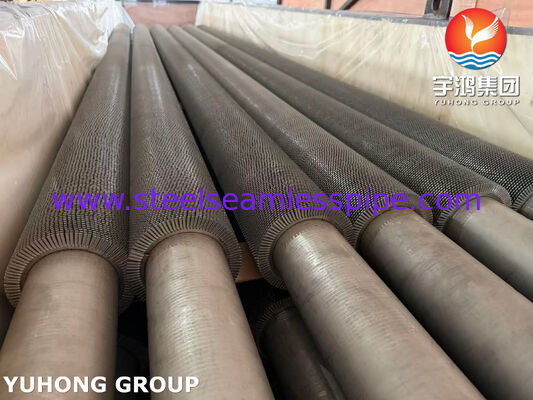
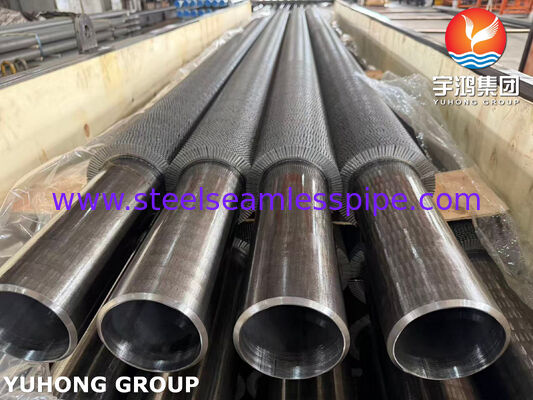
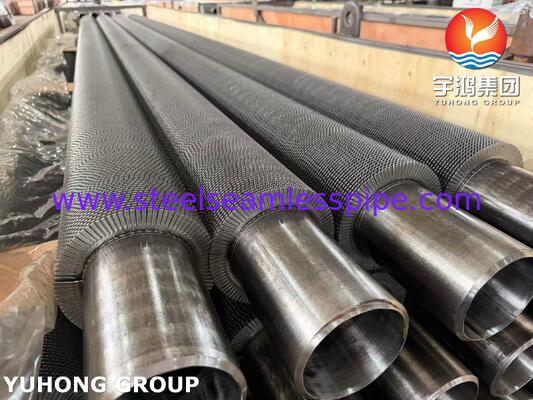
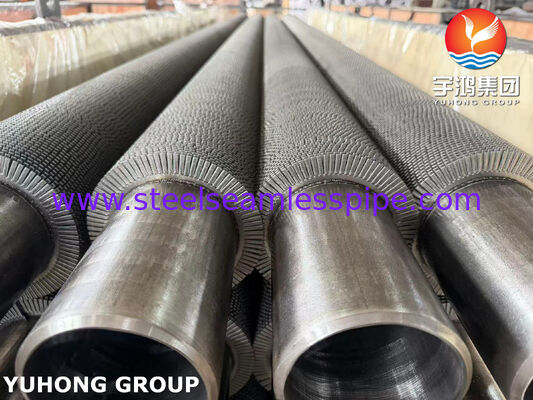
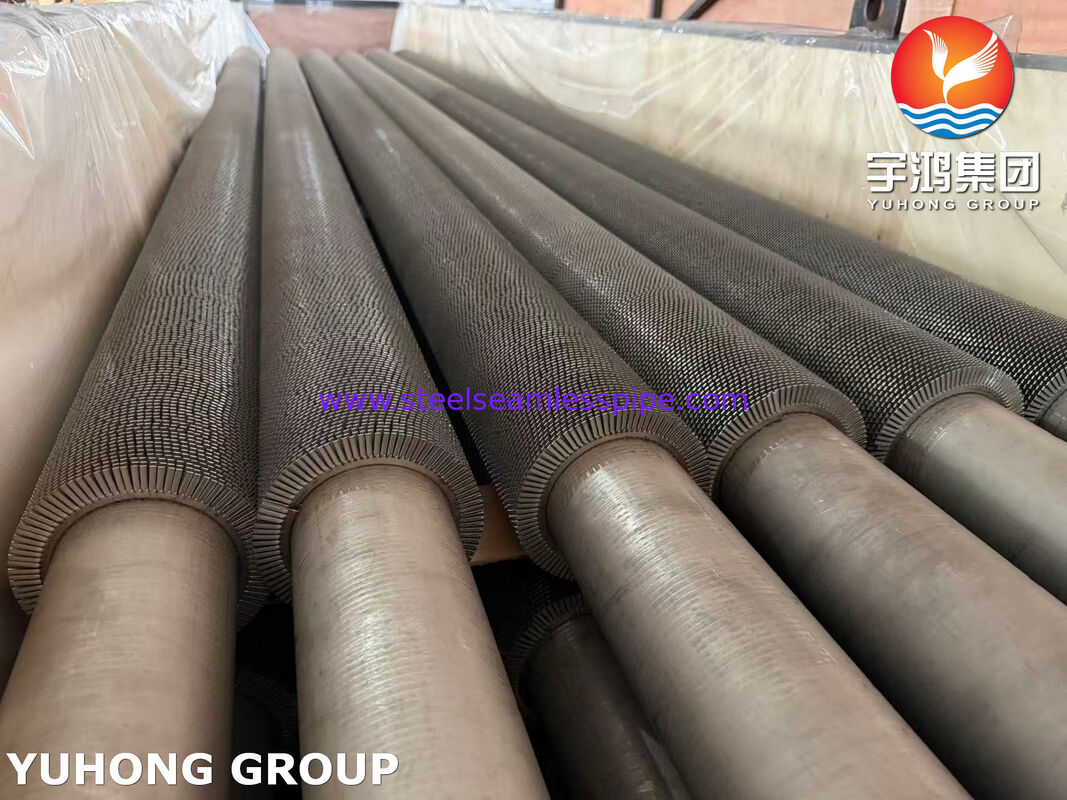
ASTM A179 serrated finned tubes for HRSG are heat-transfer tubes designed to increase the effective external heat-transfer area of heat recovery steam generators (HRSGs), particularly in lower- to moderate-temperature heat recovery sections such as economizers, feedwater preheaters, and other gas-side heat recovery modules.
The tube is manufactured from ASTM A179 seamless cold-drawn low-carbon steel, while a serrated or segmented metal fin is helically wound or otherwise mechanically attached to the tube surface. The serrated fin geometry increases the external surface area while introducing controlled turbulence into the gas stream, improving heat transfer compared with a bare tube.
ASTM A179 is specifically intended for seamless cold-drawn low-carbon steel tubes used in heat exchangers, condensers, and similar heat-transfer equipment. The standard covers tube outside diameters from 1/8 in. to 3 in. (3.2–76.2 mm).
For HRSG applications, the serrated fin design provides a practical balance between heat-transfer efficiency, gas-side pressure drop, compact equipment design, manufacturability, and maintenance accessibility.
An HRSG recovers thermal energy from hot exhaust gas and transfers that energy to water or steam. The exhaust gas passes across the finned-tube banks while water or steam flows through the tube.
The serrated fins enlarge the heat-transfer surface exposed to the exhaust gas. Instead of relying only on the relatively small outside surface of the tube, the fins provide a substantially larger area for heat exchange.
The heat-transfer process can be summarized as:
Hot exhaust gas → serrated fin → fin-to-tube connection → tube wall → internal fluid
The serrations interrupt the gas boundary layer and promote additional mixing around the fin surfaces. This can improve gas-side heat transfer while allowing designers to control pressure drop through the selection of fin height, thickness, pitch, and tube arrangement.
In an HRSG, this design is particularly useful where the gas-side heat-transfer coefficient is relatively low compared with the water-side coefficient.
ASTM A179 serrated finned tubes are commonly considered for:
The economizer transfers heat from exhaust gas to boiler feedwater before the water enters higher-temperature sections of the HRSG.
Serrated finned tubes increase the available gas-side heat-transfer area, allowing the economizer to recover more residual exhaust heat within a compact tube-bank arrangement.
For appropriate temperature ranges, serrated finned tubes can be used to preheat feedwater using recovered exhaust or process heat.
They can be incorporated into heat-recovery equipment where hot gas is available but the operating temperature is compatible with low-carbon steel tube materials.
The design is suitable for gas-to-liquid heat-transfer duties where increased external surface area is required.
Material selection should always be based on the actual tube-wall temperature, gas composition, pressure, corrosion environment, and applicable design code. ASTM A179 is a low-carbon heat-exchanger tube material and should not automatically be substituted for alloy-steel grades used in higher-temperature HRSG sections.
ASTM A179/A179M specifies seamless, cold-drawn, low-carbon steel tubes for heat exchangers, condensers, and similar heat-transfer equipment. The current ASTM listing identifies A179/A179M-24 as the active edition.
The manufacturing route is important because cold drawing provides good dimensional control and surface quality. ASTM A179 also requires heat treatment after the final cold-drawing pass at 1200°F [650°C] or higher under the referenced specification requirements.
ASTM A179 itself permits tube outside diameters from 1/8 in. to 3 in. (3.2–76.2 mm).
For serrated finned tubes used in HRSG and heat-recovery equipment, practical project sizes are normally selected according to the required heat-transfer duty, gas velocity, pressure drop, tube-bank arrangement, and fabrication requirements.
| Item | Common Range / Option |
|---|---|
| Base tube material | ASTM A179 |
| Tube OD | Approx. 12.7–63.5 mm commonly used; other sizes available |
| Tube wall thickness | Approx. 1.5–5.0 mm commonly used |
| Tube length | 3,000–12,000 mm typical; customized lengths available |
| Fin material | Carbon steel or other specified material |
| Fin height | Approx. 10–25 mm commonly used |
| Fin thickness | Approx. 0.8–2.0 mm commonly used |
| Fin pitch | Approx. 2.0–8.0 mm commonly used |
| Fin type | Serrated / segmented / helically wound |
| Fin coverage | Continuous or specified according to design |
| End configuration | Plain, un-finned, beveled, or project-specific |
The ranges above are typical engineering supply ranges rather than limits imposed by ASTM A179. Final dimensions should be confirmed against the HRSG thermal and mechanical design.
The serrated fin is manufactured with repeated interruptions or cuts along the fin strip. Compared with a completely continuous helical fin, the segmented geometry can improve gas mixing around the fin and facilitate thermal expansion behavior.
Typical design parameters include:
The optimum configuration depends on the HRSG's exhaust-gas flow rate, gas temperature, allowable pressure drop, fouling tendency, heat-transfer target, and available installation space.
For projects requiring precise thermal performance, fin dimensions should therefore be selected from the thermal design calculation rather than from a generic standard size.
ASTM A179 is a low-carbon steel grade with a relatively simple chemical composition. The specified composition is:
| Element | ASTM A179 Requirement |
|---|---|
| Carbon (C) | 0.06–0.18% |
| Manganese (Mn) | 0.27–0.63% |
| Phosphorus (P) | ≤0.035% |
| Sulfur (S) | ≤0.035% |
| Silicon (Si) | Not specified as a required alloying range |
| Chromium (Cr) | Not specified |
| Nickel (Ni) | Not specified |
| Molybdenum (Mo) | Not specified |
The ASTM specification specifically identifies carbon, manganese, phosphorus, and sulfur requirements for this grade.
The low-carbon composition supports good manufacturability and makes the material suitable for cold-drawn heat-exchanger tubing.
Typical minimum mechanical requirements for ASTM A179 tubing include:
| Property | Requirement |
|---|---|
| Tensile Strength | ≥325 MPa |
| Yield Strength | ≥180 MPa |
| Elongation | ≥35% |
| Hardness | ≤72 HRB |
These values are commonly reported for ASTM A179 tubing; the applicable purchase specification and current edition of the standard should govern final acceptance.
The relatively high elongation requirement is beneficial for tube forming and fabrication operations. Mechanical properties are subject to the applicability limits within ASTM A179, including restrictions for very small tubing and very thin walls.
A typical manufacturing route for ASTM A179 serrated finned tubes is:
Steel billet → piercing → hot rolling → cold drawing → heat treatment → straightening → cutting → dimensional inspection → fin preparation → fin attachment → serration formation/fin forming → finished finned-tube inspection → testing → marking and packaging
The ASTM A179 base tube is manufactured by the seamless process and cold drawn.
For finned-tube production, special attention is paid to:
Quality control can include both base-tube inspection and finished finned-tube inspection.
Heat analysis and, when required, product analysis verify that the base tube conforms to the specified ASTM A179 chemistry.
Tensile testing verifies tensile strength, yield strength, and elongation of the tube material.
Hardness testing confirms compliance with the specified mechanical-property requirements.
Flattening testing evaluates tube ductility and resistance to deformation. ASTM A179 identifies flattening testing among the required tube examinations.
Flaring testing evaluates the ability of the tube to undergo controlled expansion without unacceptable cracking or defects.
Where applicable, flange testing may be performed according to the purchase requirements and applicable specification.
Hydrostatic testing checks the pressure integrity of the finished tube. ASTM A179 identifies hydrostatic testing among its specified tube tests.
Eddy-current examination or another suitable NDE method may be specified by the purchaser or applicable project standard for detecting discontinuities in the tube.
Finished tubes are inspected for:
The tube and fin surfaces are examined for cracks, excessive oxidation, deformation, damaged fins, poor attachment, and other visible defects.
ASTM A179 requires finished tubes to be free of scale, with a slight amount of oxidation not considered scale.
The fin substantially increases the external surface area available for exhaust-gas heat transfer.
More heat-transfer surface can be installed within a given gas-flow envelope, helping reduce equipment size where appropriate.
Serrations interrupt the boundary layer and promote gas mixing around the fin surface.
The low-carbon ASTM A179 tube offers good ductility and is well suited to heat-exchanger fabrication.
For temperature regimes where carbon steel is technically appropriate, A179 can provide an economical alternative to higher-alloy tubing.
Fin height, pitch, thickness, tube spacing, and bare-end dimensions can be customized according to the HRSG thermal design.
We manufacture serrated finned tubes according to customer-specific thermal, dimensional, material, and inspection requirements rather than relying on a one-size-fits-all configuration.
Our supply capability can include:
For HRSG projects, customers can provide the required gas temperature, gas flow, water/steam conditions, design pressure, allowable pressure drop, tube-bank dimensions, and required heat duty, allowing the finned-tube configuration to be selected around the actual application.
ASTM A179 is a low-carbon heat-exchanger tube material, not a chromium-molybdenum alloy-steel grade. Therefore, it is generally more appropriate for suitable lower-temperature heat-recovery duties than for the hottest HRSG pressure parts.
For high-temperature economizers, superheaters, reheaters, or other sections with elevated metal temperatures, alloy grades such as ASTM/ASME T11, T12, T22, T91, or stainless grades may be required depending on the engineering design.
The final tube material should always be selected according to design temperature, design pressure, corrosion conditions, applicable boiler/pressure-vessel code, and HRSG manufacturer's engineering requirements.
Contact Person: Nacy
Tel: +8619965117039
Fax: 0086-574-88017980