Yuhong Holding Group Co.,LTD
 |
| Place of Origin: | China |
| Brand Name: | YUHONG |
| Certification: | ISO9001:2015; ISO14001:2015; ISO45001:2018; PED 2014/68/EU; WPS/PQR/WPQ; ISO 3834 |
| Model Number: | N/A |
| Minimum Order Quantity: | 500kgs |
|---|---|
| Price: | To be discussed |
| Packaging Details: | Iron frame wooden case |
| Delivery Time: | 50-120 days |
| Payment Terms: | L/C,T/T |
| Supply Ability: | 5000 meters/day |
| Product: | Studded Fin Tube | Material: | ASTM A335 P22 |
|---|---|---|---|
| Application: | Thermal Power Plants | Package: | Iron Frame Wooden Case |
| Highlight: | ASTM A335 P22 fin tubes,studded fin tubes for thermal power,P22 fin tubes with warranty |
||
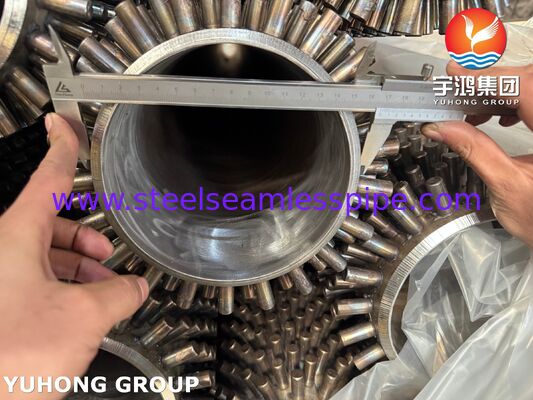
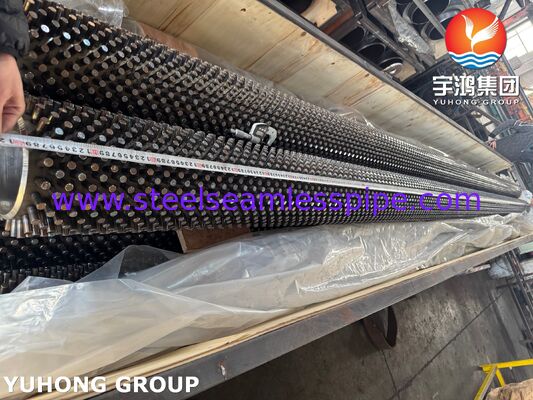
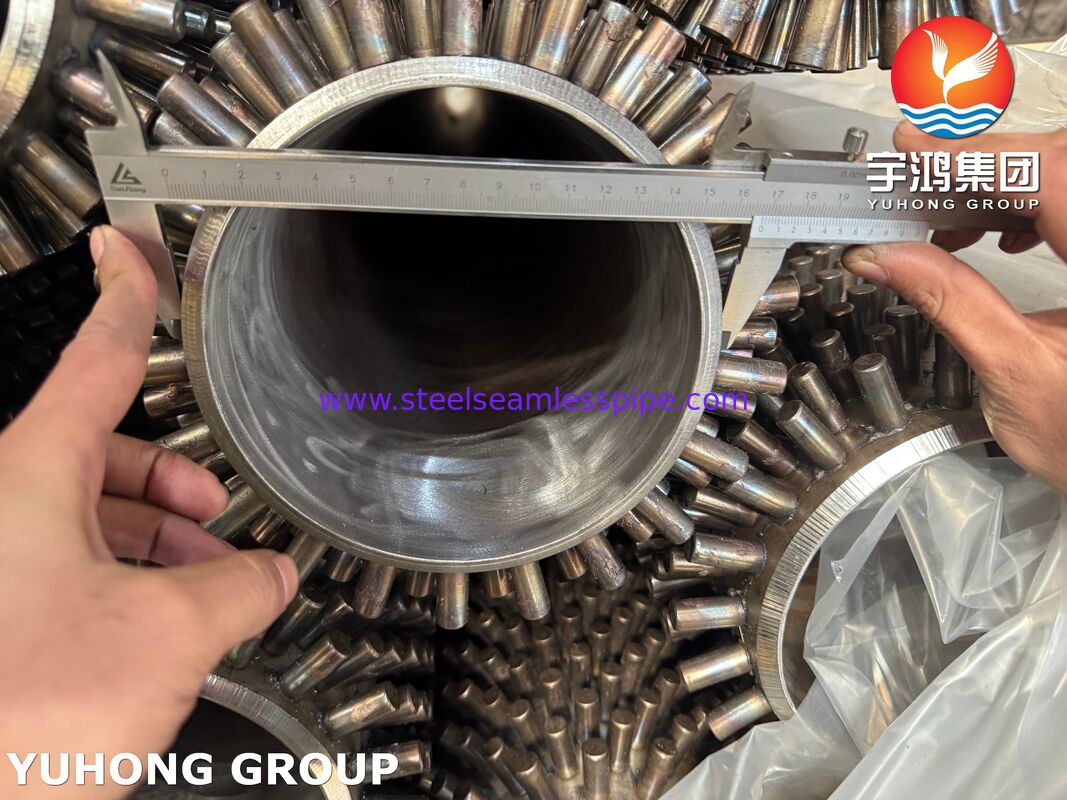
ASTM A335 P22 studded fin tubes, also known as nail-head fin tubes or studded tubes, are high-temperature heat-transfer components designed for demanding thermal power generation and industrial heat-recovery applications. The tubes combine a seamless 2¼Cr-1Mo alloy-steel P22 base tube with welded steel studs distributed around the outside surface.
Unlike conventional continuous-fin tubes, the studded configuration creates numerous individual heat-transfer projections around the tube. This design provides an enlarged gas-side heat-transfer surface while maintaining open passages between the studs, making the tubes particularly suitable for boiler convection sections, waste heat recovery equipment and high-temperature flue-gas service.
ASTM A335 P22 is specified for seamless ferritic alloy-steel pipe for high-temperature service. Its chromium-molybdenum composition provides substantially better elevated-temperature performance than ordinary carbon steel. The nominal 2¼Cr-1Mo chemistry contains approximately 1.90–2.60% Cr and 0.87–1.13% Mo.
In thermal power generation, heat-transfer surfaces frequently operate under elevated temperatures and are exposed to combustion gases. The tube material therefore needs to maintain adequate strength and dimensional stability while transferring heat efficiently.
P22 provides a useful combination of elevated-temperature strength, chromium-assisted oxidation resistance and molybdenum-enhanced high-temperature performance. The minimum tensile strength specified for P22 is 415 MPa, with a minimum yield strength of 205 MPa.
The studded configuration adds another important advantage. Instead of forming one continuous fin, individual studs create a large number of heat-transfer surfaces while leaving channels between adjacent studs. This can be advantageous in gas-side applications where fouling, ash accumulation, thermal expansion and cleaning access must be considered.
For this reason, P22 studded tubes can be considered for:
A P22 studded fin tube normally consists of:
P22 seamless base tube → welded stud attachment → dimensional inspection → surface treatment → testing → final inspection
The base tube provides the pressure-containing function, while the external studs increase the effective heat-transfer area.
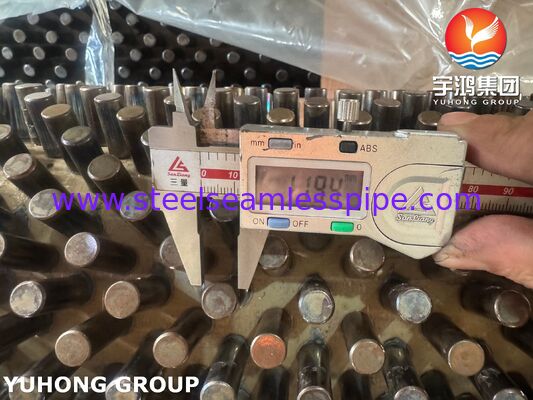
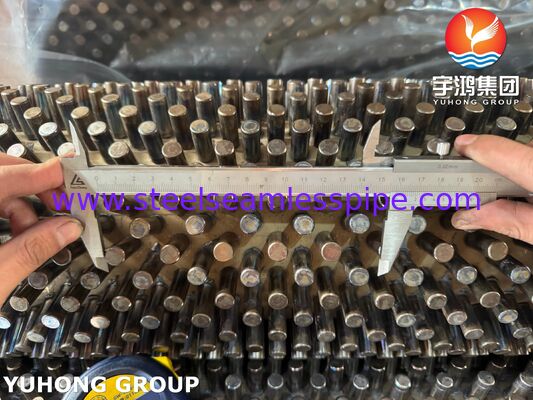
Stud dimensions, pitch, number of rows, arrangement and attachment method should be selected according to the thermal design requirements rather than using one universal configuration.
Typical configurations can include:
For power-generation applications, the final geometry should be established from the required heat-transfer coefficient, gas velocity, pressure drop, fouling characteristics, operating temperature and allowable mechanical stresses.
Because studded fin tubes are normally engineered for a particular boiler, heater or heat-recovery application, there is no single universal size range. Typical commercial configurations can include:
| Item | Common Range |
|---|---|
| Base tube OD | 25–114.3 mm |
| Base tube wall thickness | 2.5–12 mm |
| Tube length | 3–15 m |
| Stud diameter | Approx. 6–16 mm |
| Stud height | Approx. 10–25 mm |
| Stud pitch | Approx. 12–35 mm |
| Stud arrangement | Inline or staggered |
| Stud material | Carbon/alloy steel, according to design |
| Base tube | ASTM A335 P22 |
Note: These are typical engineering ranges rather than limitations of ASTM A335. Exact tube dimensions, stud geometry, pitch, attachment requirements and tolerances should be confirmed according to the customer's thermal and mechanical design.
The following values represent the commonly specified ASTM A335 P22 composition in weight percent.
| Element | ASTM A335 P22 |
|---|---|
| Carbon (C) | 0.05–0.15% |
| Manganese (Mn) | 0.30–0.60% |
| Silicon (Si) | ≤0.50% |
| Phosphorus (P) | ≤0.025% |
| Sulfur (S) | ≤0.025% |
| Chromium (Cr) | 1.90–2.60% |
| Molybdenum (Mo) | 0.87–1.13% |
Chromium (Cr) improves oxidation resistance and contributes to the alloy's high-temperature performance.
Molybdenum (Mo) improves elevated-temperature strength and resistance to softening, which is important in prolonged high-temperature operation.
The combination makes P22 particularly suitable for high-temperature power-generation equipment compared with conventional carbon-steel tube materials.
Typical minimum mechanical requirements include:
| Property | Requirement |
|---|---|
| Tensile Strength | ≥415 MPa |
| Yield Strength | ≥205 MPa |
| Elongation | ≥30%* |
| Hardness | According to applicable specification/condition |
*Elongation requirements can vary with specimen orientation and dimensions; the applicable edition of ASTM A335/A335M should govern the purchase specification.
The P22 base tube is normally supplied in an appropriate heat-treated condition, such as normalized and tempered or another condition permitted by the applicable specification.
Our ASTM A335 P22 studded fin tubes can be manufactured through a controlled sequence designed to maintain both tube integrity and stud attachment quality.
Seamless ASTM A335 P22 tube is selected according to the specified outside diameter, wall thickness, length and material requirements.
The external tube surface is cleaned and prepared to remove oil, scale, rust and other contaminants that could affect stud attachment.
Studs are manufactured to the specified diameter, height, geometry and material requirements.
The studs are attached to the external tube surface using a controlled welding process appropriate to the design. Welding parameters are monitored to achieve consistent attachment without unacceptable damage to the tube wall.
Finished tubes are checked for:
The completed tubes undergo the specified inspection and testing program before shipment.
For thermal power-generation applications, quality control should cover both the P22 pressure tube and the stud attachment.
Positive material identification or laboratory chemical analysis can be performed to verify that the base tube conforms to the specified P22 chemistry.
Tensile testing verifies the required tensile strength, yield strength and elongation of the P22 tube.
Hardness testing can be performed to confirm compliance with the applicable material and heat-treatment requirements.
Where applicable, tube samples can be subjected to flattening testing to evaluate ductility and tube integrity. ASTM A335 P22 material testing programs can include flattening and bending requirements.
Bending tests can be applied where required by the purchase specification or applicable standard.
Hydrostatic testing can be performed on the base tubes or finished assemblies according to the applicable specification, design code and purchaser requirements.
Eddy current examination can be used as a nondestructive method for detecting certain surface and near-surface discontinuities in the tube.
UT may be used where specified to examine the tube material or selected weld regions.
Each finished tube can be inspected for:
For studded tubes, attachment strength is particularly important. Representative samples can be subjected to mechanical attachment testing according to the agreed manufacturing and quality-control procedure.
P22 is a chromium-molybdenum alloy steel specifically covered by ASTM A335 for high-temperature service.
The individual studs substantially increase the external surface available for gas-side heat transfer compared with a plain tube.
The studded design can provide a durable external heat-transfer surface for demanding industrial environments.
P22's alloy composition and high-temperature mechanical properties make it appropriate for equipment exposed to repeated temperature changes.
Stud diameter, height, pitch and arrangement can be engineered to achieve the required balance between heat-transfer performance and gas-side pressure drop.
ASTM A335 P22 studded fin tubes are particularly suitable for:
Used in high-temperature boiler and heat-recovery sections where enhanced gas-side heat transfer is required.
Studded tubes can be incorporated into convection heating surfaces to recover thermal energy from combustion gases.
The tubes can be used to recover energy from high-temperature exhaust gases and transfer it to water, steam or other process fluids.
Suitable for selected high-temperature boiler heat-transfer applications requiring alloy-steel pressure tubes.
P22 studded tubes can also be engineered for high-temperature heat-transfer equipment in industrial processes.
For power-generation projects, documentation can be supplied according to project requirements, including:
Each P22 tube can be identified by heat number and production batch to maintain material traceability throughout manufacturing and inspection.
For Google SEO and international B2B buyers, I recommend positioning this product primarily around:
“ASTM A335 P22 Studded Fin Tubes for Thermal Power Generation"
rather than simply “P22 Nail Head Tubes."
The first phrase clearly combines the material + product type + application, which makes it more descriptive for engineers, procurement personnel and power-plant equipment buyers searching for this product.
Suggested URL slug:/astm-a335-p22-studded-fin-tubes-thermal-power-generation/
Suggested H1:
ASTM A335 P22 Studded Fin Tubes for Thermal Power Generation
Suggested secondary H2:
P22 Nail Head Fin Tubes for Boiler and Waste Heat Recovery Applications
This gives you a strong combination of the terms ASTM A335 P22, studded fin tube, nail head fin tube, thermal power generation, boiler, and waste heat recovery, without overloading the page with keywords.
Contact Person: Nacy
Tel: +8619965117039
Fax: 0086-574-88017980