Yuhong Holding Group Co.,LTD
 |
| Place of Origin: | China |
| Brand Name: | YUHONG |
| Certification: | ISO9001:2015; ISO14001:2015; ISO45001:2018; PED 2014/68/EU; WPS/PQR/WPQ; ISO 3834 |
| Model Number: | N/A |
| Minimum Order Quantity: | 500kgs |
|---|---|
| Price: | To be discussed |
| Packaging Details: | Plywood Case |
| Delivery Time: | 50-120 days |
| Payment Terms: | L/C,T/T |
| Supply Ability: | 5000 meters/day |
| Product: | Low Fin Tube | Material: | ASME SB111 C68700 |
|---|---|---|---|
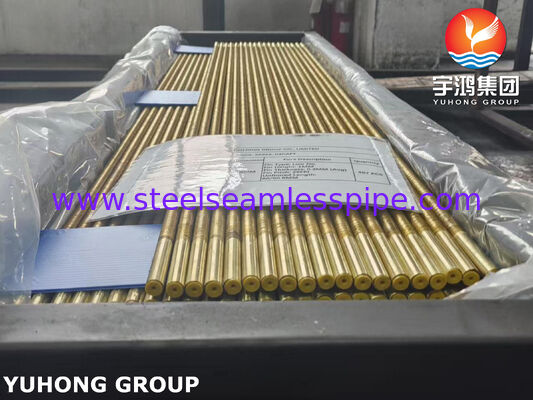
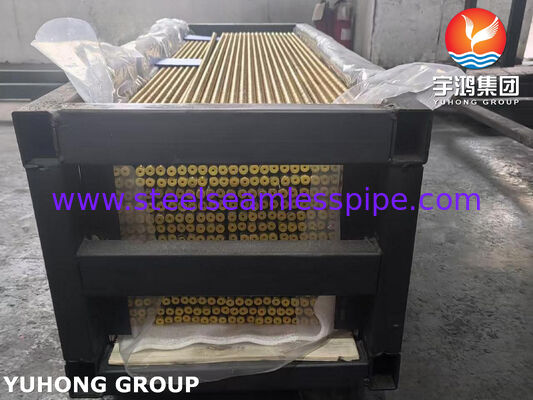
| Package: | Plywood Case |
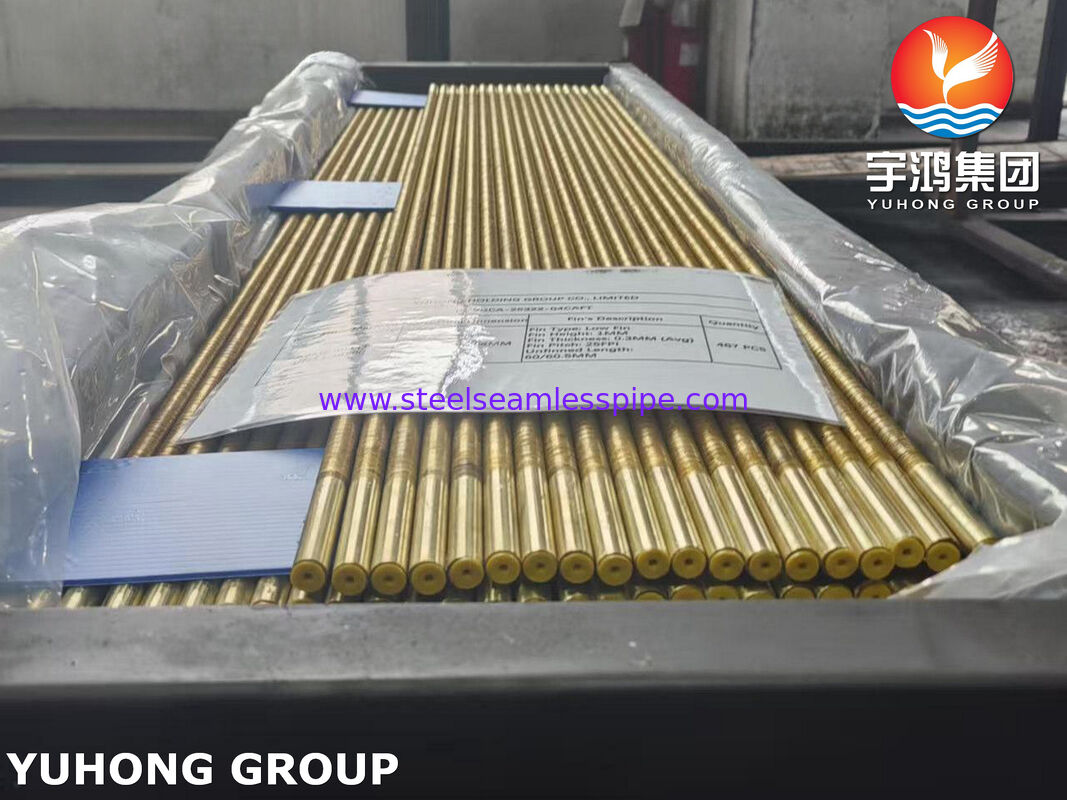
Low-Finned Tubes for Condensers, manufactured from ASME SB111 C68700 / UNS C68700 aluminum brass, are designed to increase the external heat-transfer area of condenser tubes while maintaining a compact tube geometry.
C68700, commonly identified as Aluminum Brass B / Arsenical Aluminum Brass, is a copper-zinc alloy containing aluminum and a controlled arsenic addition. ASME SB111 / ASTM B111 recognizes C68700 for seamless condenser, evaporator, and heat-exchanger tube applications.
The low-fin geometry creates a series of integral external fins around the tube surface. Compared with a plain tube of the same nominal diameter, the increased outside surface area can improve heat transfer and provide greater heat-transfer capacity within a given exchanger envelope.
These tubes are particularly suitable for surface condensers, seawater and cooling-water heat exchangers, marine condensers, desalination equipment, and industrial cooling systems where aluminum brass is selected for its combination of thermal conductivity, mechanical strength, and resistance to erosion-corrosion in suitable water-service conditions.
C68700 low-finned tubes can be used in surface condenser systems where steam is condensed on one side of the heat-transfer surface and cooling water flows through the tube.
ASTM B111 specifically identifies C68700 among copper alloys covered for surface condensers, evaporators, and heat exchangers.
The tubes can be considered for condenser and auxiliary cooling equipment in:
C68700 is widely associated with condenser and heat-exchanger tube service involving cooling water. The aluminum-brass composition is particularly relevant to marine and seawater-related equipment when the operating chemistry and water velocity are properly controlled.
Typical equipment includes:
C68700 low-finned tubes can be supplied for heat-transfer equipment used in desalination and seawater treatment systems, subject to the specific water chemistry and design conditions.
Potential applications include:
The exact dimensions should be selected according to the condenser design, thermal calculation, tube-sheet configuration, and applicable project specification.
Typical manufacturing ranges can include:
| Parameter | Typical Range |
|---|---|
| Outside diameter of base tube | 12.7–38.1 mm |
| Base tube wall thickness | 0.8–3.0 mm |
| Overall fin height | 0.5–2.5 mm |
| Fin pitch | 1.5–5.0 mm |
| Tube length | Up to approximately 18,000 mm |
| Fin type | Integral low fin |
| Tube form | Seamless |
| Temper | Annealed / light-drawn / hard-drawn or project-specified |
ASTM B111/B111M-24 covers seamless condenser tubes up to 3 1/8 in. (80 mm) diameter, although actual low-fin tube dimensions are normally determined by the exchanger design and purchaser specification.
Important: The above dimensional values are typical manufacturing ranges rather than universal ASME SB111 dimensional requirements. Final dimensions, tolerances, fin geometry, temper, and inspection requirements should be confirmed against the purchase specification and applicable edition of the standard.
Typical chemical composition requirements for UNS C68700 aluminum brass include:
| Element | Typical / Standard Limit, % |
|---|---|
| Copper (Cu) | 76.0–79.0 |
| Aluminum (Al) | 1.8–2.5 |
| Iron (Fe) | Controlled by specification |
| Zinc (Zn) | Remainder |
| Arsenic (As) | 0.02–0.06 |
| Lead (Pb) | Controlled by specification |
C68700 is classified by the Copper Development Association's UNS database as Aluminum Brass, Arsenical, with copper at approximately 76–79%, aluminum at 1.8–2.5%, and arsenic at 0.02–0.06%, with zinc forming the balance.
For contractual supply, the applicable ASME/ASTM edition and purchase specification take precedence over generalized composition tables.
Mechanical properties depend on the tube temper and applicable dimensional range. ASME SB111/ASTM B111 provides requirements according to the specified temper rather than treating all C68700 tubes as having one universal mechanical-property value. ASTM B111 recognizes conditions including annealed, light-drawn, hard-drawn, and hard-drawn/end-annealed.
Typical properties evaluated for C68700 condenser tubes include:
For a commercial product page, it is preferable to state the guaranteed values according to the ordered temper and current ASME SB111 specification, rather than presenting one mechanical-property table that could incorrectly apply to every temper.
Our low-finned C68700 condenser tubes can be manufactured through a controlled sequence such as:
ASTM B111 describes manufacturing routes including casting, extrusion, drawing, annealing, straightening, trimming, and other processes capable of producing seamless tubes in the specified condition.
To ensure suitability for condenser and heat-exchanger service, inspection can include:
Positive material identification or laboratory chemical analysis can be performed to verify the C68700 alloy chemistry.
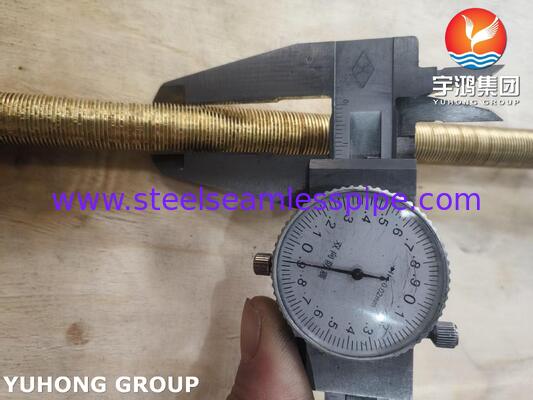
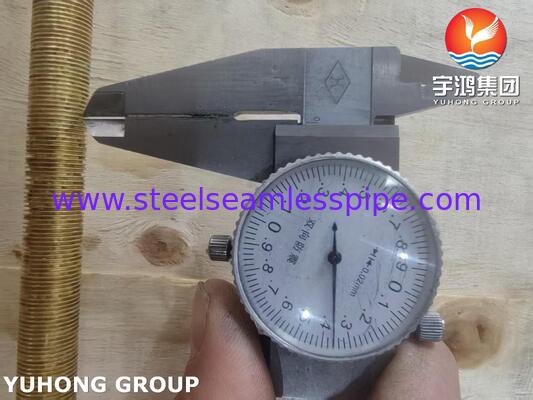
Typical dimensional checks include:
Tensile testing is performed according to the applicable material specification and ordered temper to verify mechanical performance.
Expansion testing evaluates the tube's ability to withstand controlled enlargement without unacceptable cracking or failure.
Flattening testing evaluates tube ductility and material integrity.
Eddy-current examination can be used as a nondestructive method for detecting relevant discontinuities in the tube wall.
Hydrostatic testing can be performed where specified by the purchase order or applicable standard.
Pneumatic leakage testing can also be provided when required by the project specification.
ASTM B111/B111M identifies expansion, flattening and residual-stress testing and also provides for eddy-current, hydrostatic and pneumatic examinations among its testing requirements/options.
The tube surface is inspected for:
The main purpose of the low-fin configuration is to increase the external heat-transfer area without requiring a proportionally larger base-tube diameter.
Compared with plain condenser tubes, low-finned tubes can offer:
The actual thermal advantage depends on fin geometry, fluid properties, velocity, fouling, temperature difference, pressure drop, and the complete heat-exchanger design.
C68700 combines a copper-rich matrix with aluminum and a controlled arsenic addition. Its established use in condenser and heat-exchanger tubing makes it a relevant material option for cooling-water service.
Its principal advantages for condenser applications include:
ASTM B111 specifically identifies C68700 as Aluminum Brass B for seamless condenser tubes, and the current B111/B111M scope includes surface condensers, evaporators, and heat exchangers.
Each production batch can be supplied with appropriate quality documentation, such as:
C68700 low-finned tubes can be supplied in suitable export packaging according to tube length and customer requirements.
Typical protection may include:
Each bundle can be marked with material grade, size, length, heat/lot number, quantity, and applicable specification for traceability.
ASME SB111 C68700 Low-Finned Tubes for Condensers and Heat Exchangers
This product is particularly suitable for customers looking for aluminum-brass low-finned tubes for:
Surface Condensers | Power Plant Condensers | Marine Heat Exchangers | Seawater Cooling | Desalination Equipment | Industrial Cooling Systems
Contact Person: Nacy
Tel: +8619965117039
Fax: 0086-574-88017980