Yuhong Holding Group Co.,LTD
 |
| Place of Origin: | China |
| Brand Name: | YUHONG |
| Certification: | ISO9001:2015; ISO14001:2015; ISO45001:2018; PED 2014/68/EU; WPS/PQR/WPQ; ISO 3834 |
| Model Number: | N/A |
| Minimum Order Quantity: | 500kgs |
|---|---|
| Price: | To be discussed |
| Packaging Details: | Iron frame wooden case |
| Delivery Time: | 50-120 days |
| Payment Terms: | L/C,T/T |
| Supply Ability: | 5000 meters/day |
| Material: | ASME SB163 NO8825 | Application: | Dry Cooler |
|---|---|---|---|
| Package: | Iron Frame Wooden Case |
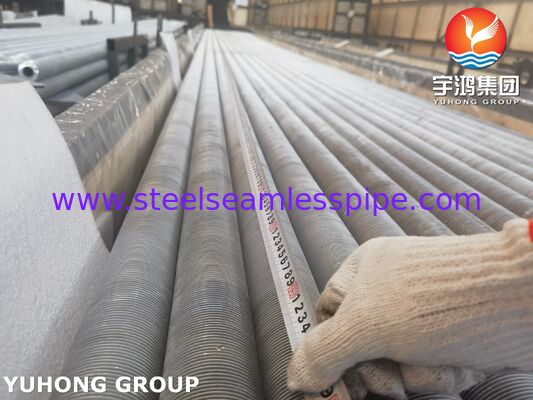
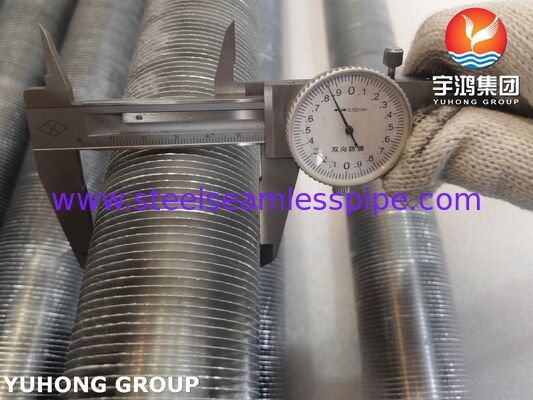
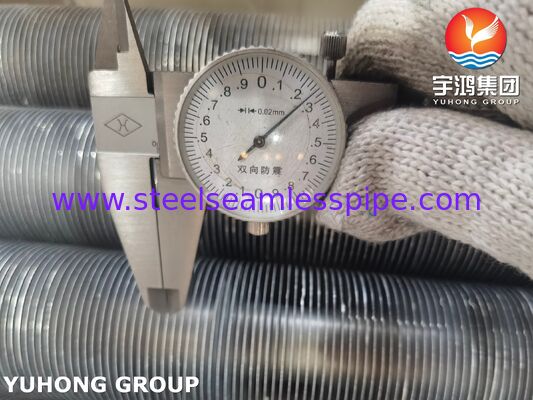
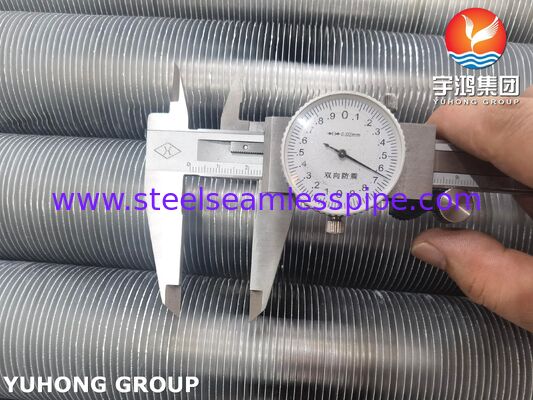
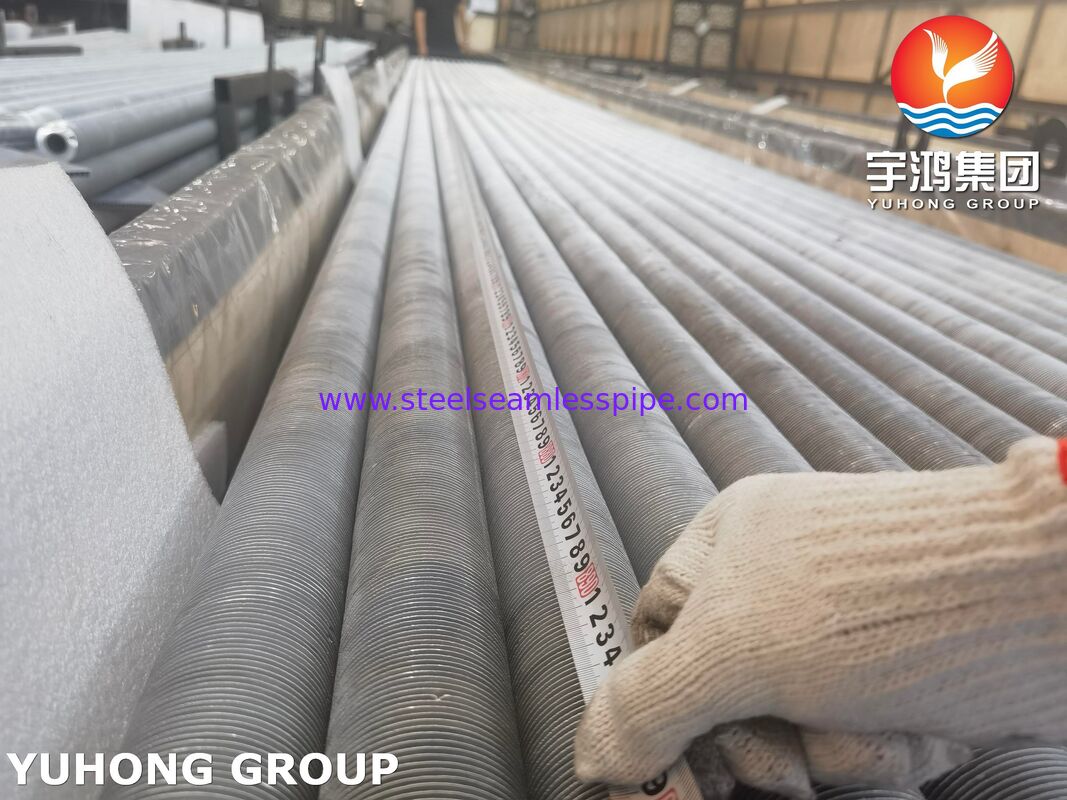
Extruded Finned Tubes for Dry Coolers manufactured with ASME SB163 UNS N08825 (Incoloy 825) base tubes are designed for demanding air-cooled heat-transfer applications where corrosion resistance, mechanical integrity, and reliable long-term operation are important.
UNS N08825 is a nickel-iron-chromium-molybdenum-copper alloy with titanium stabilization. Its combination of chromium, molybdenum, copper, and nickel provides strong resistance to a broad range of corrosive environments. For dry-cooler service, this alloy can be selected when the heat-transfer equipment requires a higher level of corrosion resistance than conventional carbon-steel or stainless-steel tubing can provide.
Our extruded finned tubes use an aluminum sleeve or fin material mechanically bonded over the specified N08825 base tube. The extrusion process creates a close and continuous contact between the fin and tube, providing an efficient thermal-transfer path from the tube wall to the surrounding air.
The resulting tube assembly is suitable for dry coolers, air-cooled heat exchangers, air-cooled condensers, process coolers, and other forced- or induced-draft air-cooling equipment.
ASME/ASTM B163 covers seamless nickel and nickel-alloy tubes for condenser and heat-exchanger applications and includes UNS N08825 among the specified alloys.
Dry coolers depend heavily on efficient air-side heat transfer. Because air has relatively low thermal conductivity compared with water, a large external heat-transfer surface is generally required. Extruded fins substantially increase the effective outside surface area while maintaining a compact heat-exchanger configuration.
The UNS N08825 base tube is particularly useful where the tube-side environment may expose the heat exchanger to corrosive media or where enhanced alloy performance is required.
The alloy contains approximately 38–46% nickel, 19.5–23.5% chromium, 2.5–3.5% molybdenum, and 1.5–3.0% copper, with titanium added for stabilization.
The combination of the corrosion-resistant N08825 tube and high-conductivity extruded aluminum fins provides a practical solution for applications requiring both tube-side corrosion resistance and efficient air-side heat dissipation.
Our ASME SB163 UNS N08825 extruded finned tubes can be engineered for:
Used in closed-loop cooling systems where process fluid or water/glycol mixtures are cooled by ambient air rather than by direct water evaporation.
Suitable for equipment where heat must be transferred from process fluid to atmospheric air through finned tube bundles.
Can be specified for chemical and process industries where corrosion resistance is an important consideration.
Applicable to auxiliary cooling systems and other air-cooled heat-transfer equipment where alloy selection is dictated by the operating environment.
UNS N08825 can be considered where conventional stainless-steel or carbon-steel tube materials may not provide the desired corrosion resistance.
An extruded finned tube normally consists of:
UNS N08825 seamless base tube + aluminum fin sleeve + extruded fin profile
During manufacturing, an aluminum tube or sleeve is positioned around the base tube and mechanically extruded to form the fins. The extrusion process tightly engages the fin material with the tube surface.
This construction offers several important advantages:
For dry coolers, the exact fin height, thickness, pitch, number of fins per unit length, and aluminum alloy should be selected according to the required thermal duty, air velocity, pressure drop, ambient conditions, and mechanical requirements.
The ASME SB163 tube specification covers seamless nickel and nickel-alloy tubes up to 3 in. (76.2 mm) outside diameter, with specified wall-thickness limitations.
For extruded finned tubes used in dry coolers, commonly engineered base-tube sizes include:
| Item | Typical Range |
|---|---|
| Base tube OD | 12.7–76.2 mm |
| Base tube wall thickness | Approx. 1.0–4.0 mm |
| Overall fin OD | Approx. 30–120 mm |
| Fin height | Approx. 5–25 mm |
| Fin thickness | Approx. 0.8–3.0 mm |
| Fin pitch | Approx. 1.5–6.0 mm |
| Tube length | 3,000–12,000 mm |
| Fin material | Aluminum alloy, project specified |
| Tube material | ASME SB163 UNS N08825 |
Note: These are common engineering ranges rather than universal SB163 dimensional requirements. Final dimensions should be confirmed according to the dry-cooler thermal design and purchaser's specification.
ASTM B163 specifically recognizes outside-diameter/average-wall and outside-diameter/minimum-wall tube configurations.
Typical specified chemical requirements for UNS N08825 include:
| Element | Requirement, % |
|---|---|
| Nickel (Ni) | 38.0–46.0 |
| Chromium (Cr) | 19.5–23.5 |
| Iron (Fe) | 22.0 min. |
| Molybdenum (Mo) | 2.5–3.5 |
| Copper (Cu) | 1.5–3.0 |
| Titanium (Ti) | 0.6–1.2 |
| Manganese (Mn) | 1.0 max. |
| Silicon (Si) | 0.5 max. |
| Carbon (C) | 0.05 max. |
| Aluminum (Al) | 0.2 max. |
| Sulfur (S) | 0.03 max. |
Nickel, chromium, molybdenum and copper are particularly important to the alloy's corrosion-resistance characteristics, while titanium provides stabilization.
For UNS N08825 tube, mechanical requirements depend on the applicable product specification and supplied condition. A commonly referenced set of minimum properties for annealed tube includes:
| Property | Typical Minimum Requirement |
|---|---|
| Tensile Strength | 586 MPa |
| Yield Strength, 0.2% offset | 241 MPa |
| Elongation | 30% |
The applicable ASME/ASTM specification and purchase order should govern the final acceptance values for the supplied tube. Published B163 information identifies tensile strength, yield strength, elongation, and hardness among the required mechanical characteristics.
To ensure reliable performance in dry-cooler service, our extruded finned tubes can be inspected at both the base-tube stage and the finished finned-tube stage.
Positive material identification and/or laboratory chemical analysis can be performed to verify the UNS N08825 composition.
Tensile testing verifies:
These are among the mechanical requirements addressed by ASTM B163.
Rockwell hardness testing can be performed according to the applicable specification.
Hydrostatic testing can be specified to identify leakage or pressure-containing defects in the base tube.
Nondestructive electrical examination can be applied to identify discontinuities in seamless nickel-alloy tubing. Applicable tube standards specify nondestructive testing requirements and procedures.
Finished tubes can be checked for:
The extrusion process and finished assembly can be inspected to verify proper mechanical engagement between the aluminum fin and N08825 base tube.
The tube and fin surfaces are examined for visible defects, dents, cracks, excessive scratches, deformation, fin damage, and other manufacturing abnormalities.
Positive Material Identification can be offered where required to confirm that the base tube corresponds to UNS N08825.
Our typical manufacturing route is:
UNS N08825 seamless tube → Incoming inspection → Surface preparation → Aluminum sleeve assembly → Extrusion → Fin forming → Dimensional inspection → Fin/tube bonding inspection → Cutting → Final inspection → Packing
The extrusion process is carefully controlled to obtain uniform fin geometry and close contact between the aluminum fin and the nickel-alloy tube.
For large dry-cooler projects, fin geometry can be customized according to:
Corrosion-resistant base tube
UNS N08825 provides a nickel-alloy solution for demanding environments.
High air-side heat-transfer efficiency
Extruded fins increase the external surface area available for heat transfer.
Strong fin-to-tube contact
The extrusion process provides close mechanical contact between the fin and tube.
Compact heat-exchanger design
A larger effective surface area allows high heat-transfer capacity within a relatively compact bundle.
Customizable geometry
Tube diameter, wall thickness, fin height, pitch, thickness and overall length can be manufactured according to project requirements.
Suitable for engineered dry-cooler systems
The finned tubes can be incorporated into forced-draft or induced-draft air-cooling equipment.
Upon request, the supply package can include:
Heat numbers can be maintained from the raw N08825 tube through finished finned-tube production for project traceability.
| Parameter | Specification |
|---|---|
| Product | Extruded Finned Tubes for Dry Coolers |
| Base Tube Standard | ASME SB163 |
| Base Tube Grade | UNS N08825 |
| Alloy | Nickel-Iron-Chromium-Molybdenum-Copper Alloy |
| Common Trade Name | Incoloy 825 |
| Tube Type | Seamless |
| Fin Type | Extruded Finned Tube |
| Typical Fin Material | Aluminum alloy |
| Main Application | Dry Coolers |
| Other Applications | ACHE, air-cooled heat exchangers, process coolers |
| Tube OD | Approx. 12.7–76.2 mm |
| Tube Length | Typically 3–12 m |
| Fin Height | Approx. 5–25 mm |
| Fin Pitch | Approx. 1.5–6.0 mm |
| Inspection | Chemical, tensile, hardness, dimensional, hydrostatic/NDT and visual inspection |
| Surface | Clean and free from harmful defects |
| Documentation | MTC and inspection records available |
Contact Person: Nacy
Tel: +8619965117039
Fax: 0086-574-88017980