Yuhong Holding Group Co.,LTD
 |
| Place of Origin: | China |
| Brand Name: | YUHONG |
| Certification: | ISO9001:2015; ISO14001:2015; ISO45001:2018; PED 2014/68/EU; WPS/PQR/WPQ; ISO 3834 |
| Model Number: | N/A |
| Minimum Order Quantity: | 500kgs |
|---|---|
| Price: | To be discussed |
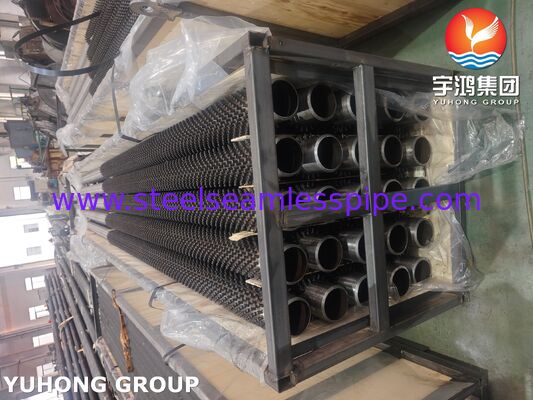
| Packaging Details: | Plywood case or Iron frame wooden case |
| Delivery Time: | 50-120 days |
| Payment Terms: | L/C,T/T |
| Supply Ability: | 5000 meters/day |
| Product: | Studded Fin Tube | Material: | ASTM A335 P9 |
|---|---|---|---|
| Application: | Air Cooler Condenser | Package: | Plywood Case Or Iron Frame Wooden Case |
ASTM A335 P5 studded tubes for economizers are engineered heat-transfer components designed for high-temperature boiler systems, industrial waste-heat recovery equipment, and other demanding thermal applications. Manufactured using 5Cr-0.5Mo chromium-molybdenum alloy steel, these tubes combine elevated-temperature strength, oxidation resistance, and reliable performance in appropriately designed operating environments.
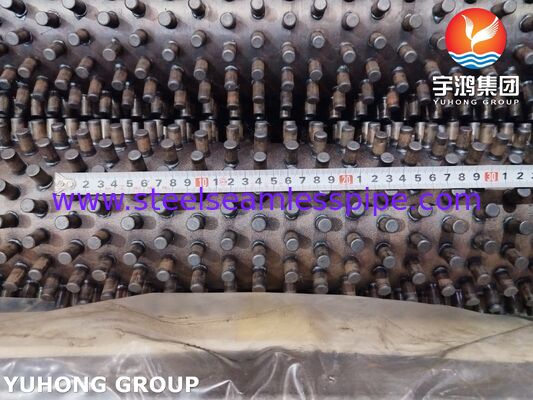
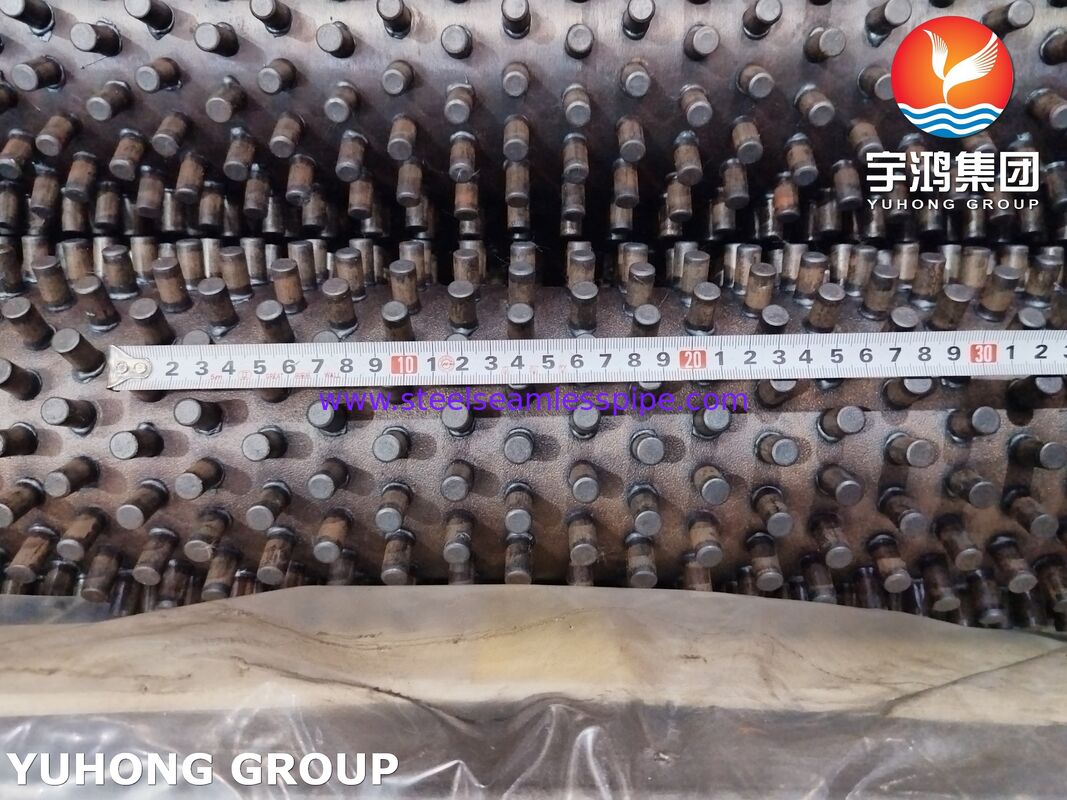
Studded tubes feature solid metal studs welded onto the outer surface of the base tube. The studs increase the effective heat-transfer surface area and promote heat exchange between the tube wall and the surrounding gas stream. They are particularly useful in applications where gas-side heat transfer is limited or where conventional finned tubes may be less suitable because of ash, dust, or other challenging process conditions.
ASTM A335 P5 is a chromium-molybdenum alloy steel grade commonly associated with elevated-temperature pressure service. Its alloy composition provides useful resistance to high-temperature oxidation and improved thermal-service performance compared with ordinary carbon steel, subject to the actual operating conditions and corrosion environment.
Our studded tubes can be manufactured to customer drawings and project specifications, with customized tube dimensions, stud geometry, welding procedures, and surface finishes to meet the requirements of industrial economizers and heat-recovery systems.
High-temperature alloy steel: ASTM A335 P5 base tubes are suitable for properly engineered elevated-temperature applications.
Enhanced heat-transfer surface: Welded studs increase the available external surface area for gas-side heat exchange.
Robust stud attachment: Stud welding is selected according to the required mechanical integrity, service conditions, and applicable welding procedures.
Application flexibility: Stud diameter, height, spacing, arrangement, and tube length can be customized.
Industrial fabrication: Production can be coordinated with specified dimensional tolerances, inspection requirements, and project documentation.
Custom engineering: Suitable configurations can be developed for new installations, replacement equipment, and heat-recovery system upgrades.
Studded tubes can be incorporated into economizer designs to recover sensible heat from flue gas and transfer it to boiler feedwater or another designated working fluid. The final arrangement depends on the boiler design, temperature profile, and allowable gas-side pressure drop.
In industrial furnaces, combustion systems, and process-heating plants, studded tubes can help recover thermal energy from exhaust gases that would otherwise be discharged.
Appropriately designed studded-tube assemblies may be used in selected boiler heat-recovery sections where high-temperature alloy steel and a mechanically robust external surface are required.
Heat-recovery equipment in refineries and petrochemical plants may use alloy-steel studded tubes where the process temperature, pressure, and corrosion conditions justify the material selection.
Other potential applications include specialized thermal oxidizers, fired-heater heat-recovery sections, and industrial gas-cooling systems, subject to detailed engineering assessment.
The following are representative manufacturing ranges rather than mandatory dimensions specified by ASTM A335. Actual availability, tolerances, and design suitability should be confirmed against the project requirements.
| Item | Typical specification |
|---|---|
| Product name | Studded Tubes for Economizers |
| Base tube material | ASTM A335 P5 / ASME SA335 P5 where specified |
| Material type | 5Cr-0.5Mo chromium-molybdenum alloy steel |
| Base tube manufacturing | Seamless alloy-steel pipe |
| Outside diameter | Approximately 25.4–168.3 mm |
| Wall thickness | Approximately 3.2–20 mm |
| Tube length | Typically 3,000–12,000 mm; other lengths by agreement |
| Stud material | Selected to suit tube material, service temperature, and project requirements |
| Stud diameter | Approximately 8–25 mm |
| Stud height | Approximately 10–40 mm |
| Stud arrangement | Inline, staggered, or drawing-specific |
| Stud spacing | Customized to thermal and mechanical design |
| Stud attachment | Qualified welding process suitable for the specified design |
| Surface condition | As manufactured, cleaned, or otherwise specified |
| Documentation | Material test certificates and inspection records as agreed |
Important: These dimensions are indicative product-manufacturing ranges, not universal ASTM requirements. The stud material, weld design, attachment method, and dimensional tolerances must be agreed upon before production.
ASTM A335 P5 is a chromium-molybdenum alloy steel. The following table gives the commonly specified composition limits for Grade P5, subject to confirmation against the governing standard edition and material certificate.
| Element | Composition, % by mass |
|---|---|
| Carbon (C) | 0.15 max |
| Manganese (Mn) | 0.30–0.60 |
| Phosphorus (P) | 0.025 max |
| Sulfur (S) | 0.025 max |
| Silicon (Si) | 0.50 max |
| Chromium (Cr) | 4.00–6.00 |
| Molybdenum (Mo) | 0.45–0.65 |
The chromium content contributes to oxidation resistance at elevated temperatures, while molybdenum supports strength and resistance to thermal softening. The balance of these properties makes P5 a candidate for appropriately designed high-temperature pressure piping and heat-transfer equipment.
Chemical composition should be verified using the applicable ASTM A335 requirements and the heat analysis or product analysis provisions specified in the purchase order.
The following are commonly specified minimum mechanical requirements for ASTM A335 P5. Confirm the applicable grade designation, standard edition, product form, and any additional project requirements before release for manufacture.
| Property | Typical requirement |
|---|---|
| Tensile strength | 415 MPa minimum |
| Yield strength | 205 MPa minimum |
| Elongation | According to applicable specimen and standard requirements |
| Hardness | As required by the governing specification and purchase order |
Mechanical properties are established through testing of the base tube in accordance with the applicable material specification. Stud welding and any subsequent heat treatment can affect local material properties; weld qualification and additional examinations should therefore be specified when required by the design.
Seamless ASTM A335 P5 tubes are procured to the required outside diameter, wall thickness, length, and material condition. Material identification and certification are checked before fabrication.
Tubes are cut to the specified length, and the ends are prepared to suit the downstream assembly and installation requirements.
Studs are manufactured or selected to the specified diameter, height, material, and geometry. Stud material compatibility is assessed against operating temperature, tube chemistry, and the welding procedure.
Studs are attached using an approved, qualified welding procedure appropriate for the selected materials and design. Welding parameters are controlled to achieve the required attachment quality while limiting detrimental effects on the base material.
Post-weld heat treatment is performed when required by the applicable construction code, qualified welding procedure, material requirements, or project specification. The temperature cycle and records are documented as applicable.
Finished tubes undergo dimensional checks and the specified visual, weld-integrity, material-verification, and nondestructive examinations. Results are recorded in accordance with the inspection and test plan.
Quality assurance for ASTM A335 P5 studded tubes should cover both the seamless base tube and the welded stud attachments. The precise inspection scope depends on the purchase order, design code, service conditions, and agreed acceptance criteria.
1. Material Certificate Review
Review material test certificates for grade, heat number, chemical composition, mechanical test results, heat treatment condition, and traceability.
2. Chemical Analysis
Verify the chemical composition using certified mill test results and, where required, independent product analysis or suitable analytical testing.
3. Tensile Testing
Check tensile strength, yield strength, and elongation in accordance with the applicable base-tube specification and referenced test methods.
4. Hardness Testing
Perform hardness testing where required by the material specification, welding procedure, heat-treatment requirements, or project inspection plan.
5. Dimensional Inspection
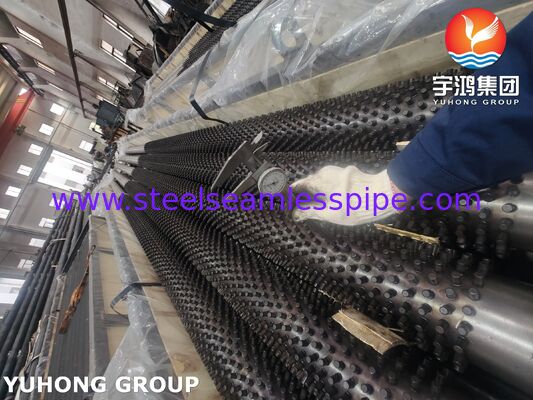
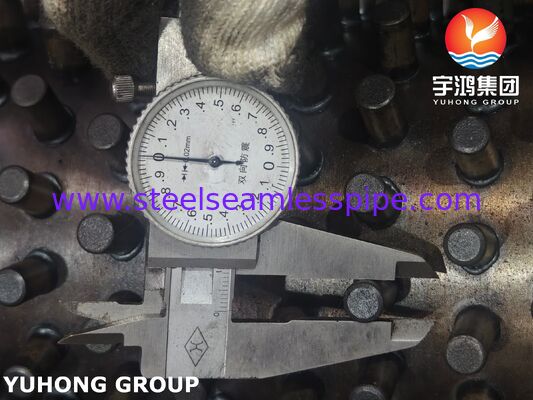
Measure tube outside diameter, wall thickness, length, straightness, stud diameter, stud height, stud spacing, and overall configuration against approved drawings.
6. Visual Inspection
Examine the tube surface, stud placement, weld appearance, and accessible weld areas for visible defects, incomplete attachment, excessive spatter, or unacceptable surface conditions.
7. Stud Weld Integrity Testing
Use an agreed examination method, such as representative bend, hammer, or other qualified attachment tests where appropriate. The method, sampling frequency, and acceptance criteria must be defined by the approved procedure or project specification.
8. Nondestructive Examination
Liquid penetrant, magnetic particle, ultrasonic, or radiographic examination may be specified where technically appropriate for the geometry and anticipated defect type. Not every method is suitable for every stud-weld configuration, and the required examination extent should be agreed in advance.
9. Hydrostatic or Alternative Leak Testing
The base pipe is tested in accordance with the governing ASTM A335 requirements or an expressly permitted alternative. Additional testing of a completed studded assembly should follow the applicable design and purchase specification.
10. Heat-Treatment Verification
Where post-weld heat treatment is required, verify the recorded temperature cycle, holding time, and applicable process documentation.
11. Final Documentation
Supply the agreed inspection and test records, material certificates, traceability documents, and dimensional reports. Welding procedure and welder qualification records can be included when required by contract.
Improved external heat-transfer area compared with an otherwise similar plain tube.
Potentially improved heat recovery where gas-side convection is the controlling resistance.
Flexible stud geometry to meet project-specific thermal and mechanical requirements.
Alloy-steel base material option for elevated-temperature service.
Adaptability to selected dusty or ash-bearing gas streams when the layout, stud spacing, and cleaning provisions are properly engineered.
Fabrication to customer drawings for replacement and new-build equipment.
Actual heat-transfer performance depends on gas properties, flow velocity, tube pitch, stud geometry, fouling, temperature differences, and the overall heat-exchanger design. Studded tubes do not automatically provide superior performance in every service.
We focus on specification-driven fabrication for industrial heat-transfer applications. Each order can be defined around the base tube grade, tube dimensions, stud arrangement, attachment procedure, inspection scope, traceability requirements, and delivery documentation.
Our production planning emphasizes:
Material grade and heat-number traceability.
Dimensional control against approved drawings.
Defined welding and inspection procedures.
Inspection records tailored to the agreed quality plan.
Customization for economizers, boilers, and industrial waste-heat recovery systems.
Contact Person: Nacy
Tel: +8619965117039
Fax: 0086-574-88017980